Net Zero Targets: Where 33 Companies, From Apple to Kering, Stand Now

Between its 2025 and 2026 proxy statements, Delta Air Lines changed one word. Net zero for its airline operations by 2050 was a goal, and it is now an “aspiration”. The net zero target tracker collects changes of that size, company by company, in the documents that record them: proxy statements filed with the Securities and Exchange Commission, annual reports on Form 20-F, remuneration reports, registration documents and board decisions, each opened for this page and current to 21 November 2026.
Each table gives the climate target, the change in executive pay from the previous plan to the current one, what came in, and the source with its date. Twenty-six entries are verified in full, and seven are marked partly verified, where a weight, a prior year or a sub-measure remains open. Percentages are weights within one plan, the annual bonus or the long-term plan, and compare only within it. For the wider record of company net zero pledges, beyond the 33 companies here, the reference is Net Zero Tracker, run by the Energy & Climate Intelligence Unit, Data-Driven EnviroLab, NewClimate Institute and Oxford Net Zero.
Part of the dossier on the ESG backlash. Find a company: Accor · Airbus · Apple · BlackRock · bp · Burberry · Coca-Cola · Delta Air Lines · Eni · Heidelberg Materials · Hermès · Hilton · Holcim · HSBC · IHG Hotels & Resorts · Kering · LVMH · Marriott International · Microsoft · Moncler · Nike · Oracle · Prada · Procter & Gamble · Ralph Lauren · Rolls-Royce Holdings · Safran · Salesforce · Shell · Starbucks · UBS · Valero Energy · Vinci
Energy: The Net Zero Targets of bp, Shell, Eni and Valero
Both bp and Shell keep a net zero target for 2050, and the change sits in what their executives are paid for. At bp the emissions measure left the annual bonus while emissions gained weight in the long-term plan, and at Shell the energy transition condition in the long-term plan fell from 25 to 20 percent. The Italian group Eni kept both plans as they were, while the American refiner Valero let its Energy Transition Modifier expire and listed uncertain returns among its reasons.
| Company | Climate target today | Pay: before → now | What came in | Source |
|---|---|---|---|---|
| bp United Kingdom | Net zero by 2050 or sooner for Scope 1 and 2 emissions within bp’s operational control; “Our ambition to reach net zero by 2050 remains unchanged”. | Annual bonus 2025: operated carbon emissions 15% → 2026: removed. Long-term plan: emissions 15% (2025–27) → 20% (2026–28), Scope 1 and 2. | Financial weight in the annual bonus 55% → 65%. Long-term plan 2026–28: shareholder returns 30%, cash generation 25%, ROACE 25%. | Annual Report and Form 20-F 2025, pp. 94, 109 6 March 2026 |
| Shell United Kingdom | Net zero emissions energy business by 2050; Scope 1 and 2 emissions halved by 2030 against 2016. The 2035 net carbon intensity target was retired in March 2024. | Annual bonus: energy transition 15%, unchanged; its customer metric moves from EV charge points to EV gross margin growth. Long-term plan: energy transition condition 25% (2025) → 20% (2026). | Normalised free cash flow per share growth in the long-term plan. | Form 20-F 2025, pp. 175–180 Form 20-F 2024 12 March 2026 |
| Eni Italy | Carbon neutrality by 2050. | Unchanged 2025 → 2026. Annual bonus: net Scope 1 and 2 upstream emissions 20%. Long-term plan: 35% environmental sustainability and energy transition, of which 20% Scope 1 and 2 and 15% biojet production capacity. | No new measure. | Remuneration Report 2026 Remuneration Report 2025 23 March 2026 |
| Valero Energy United States | 2035 target for Scope 1 and 2 refinery emissions, reduced or displaced, “on track”. The proxy names no net zero target. | Energy Transition Modifier, up to ±25% on performance share vesting (2021–24) → expired from the 2025 grants. Reasons given: purpose fulfilled, and “adverse conditions and uncertainties” around expected returns on low-carbon fuels. | Relative total shareholder return as the sole long-term measure; the cap for negative TSR removed. | DEF 14A 2026, pp. 24–25 19 March 2026 |
A note from The Silent Luxury
Good reading deserves to find you again.
Aviation: The Net Zero Targets of Delta, Rolls-Royce and Airbus
Aviation keeps its 2050 dates and divides on pay. At Delta the goal has become an aspiration. Rolls-Royce, which keeps net zero by 2050, removed the emissions measure from its 2026 long-term plan. The continental manufacturers moved the other way or held their course: Airbus built a 30 percent sustainability block into its long-term plan, and Safran kept its climate criteria.
| Company | Climate target today | Pay: before → now | What came in | Source |
|---|---|---|---|---|
| Delta Air Lines United States | Net zero emissions from airline operations by 2050, now an “aspiration” (2026); in 2025 a “goal”. | Unchanged: financial and operational measures in 2025 and 2026, pre-tax income, operational goals and customer scores in the annual plan; unit revenue, customer service and TSR in the long-term plan. Sustainability had no weight in either year. | No new measure. | DEF 14A 2026, pp. 13, 33 DEF 14A 2025, p. 13 24 April 2026 |
| Airbus Netherlands and France Partly verified | Stated in neither of the documents reviewed. | Long-term plan 2022: EPS 75%, free cash flow 25%, sustainability 0% → 2025 policy: sustainability 30% (Scope 1 and 2 CO2, Scope 3 use of products, people engagement). Annual bonus: sustainability 10%. Sub-weights within the 30% open. | Sustainability block in the long-term plan, including emissions from aircraft in use. | 2025 Remuneration Policy AGM 2026 Information Notice AGM 14 April 2026 |
| Rolls-Royce Holdings United Kingdom | Net zero by 2050; Scope 1 and 2 emissions cut by 46% by 2030 against 2019. | Long-term plan 2025: Scope 1 and 2 emissions 10% → 2026: removed. The company “may consider reinstating” an emissions target for 2028–30. | Free cash flow, operating margin and relative TSR, one third each. | 2025 Annual Report, pp. 20, 87 4 March 2026 |
| Safran France | Scope 1 and 2 emissions cut by 45% against 2018, as a pay target for 2026; net zero year stated in neither of the documents reviewed. | Unchanged 2025 → 2026. Annual bonus: CSR 12.3%, including climate goals. Long-term plan: CSR 20% (CO2 reduction, women in leadership, accident rate). | No new measure. | Integrated Report 2025, remuneration policy 2026 |
Cement: Holcim, Heidelberg Materials and Vinci
The cement makers still pay for CO2. Holcim and Heidelberg Materials both tie executive pay to CO2 per tonne of cement or cementitious material, and both kept their weights. In the annual bonus at Heidelberg Materials, a CO2 multiplier between 0.7 and 1.3 acts on net income, and for 2025 it stood at 1.03. At Vinci, cuts to the group’s own emissions counted among the ESG criteria of the 2025 bonus, at 5 percent.
| Company | Climate target today | Pay: before → now | What came in | Source |
|---|---|---|---|---|
| Holcim Switzerland | “Commitment to building a net-zero future with science-based targets”. | Unchanged 2024 → 2025. Performance share plan: sustainability one third, of which climate (Scope 1 CO2 per tonne of cementitious material) half, about 16.7% of the plan; circularity and freshwater the rest. | No new measure. | Compensation Report 2025 Compensation Report 2024 27 February 2026 |
| Heidelberg Materials Germany | CO2 reduction as the “central lever” for its 2030 sustainability commitments; net zero year stated in neither of the documents reviewed. | Held. Annual bonus: CO2 multiplier of 0.7 to 1.3 on net income (2025: 546 kg net CO2 per tonne of cement against a 547 kg target, factor 1.03). Long-term plan 2025–28: CO2 per tonne of cement 25%. | ESG target in the long-term plan since 2024. | Remuneration Report 2025, pp. 12–13, 15, 20 25 March 2026 |
| Vinci France Partly verified | Scope 1 and 2 emissions cut by 40% by 2030 against 2018, “ahead of schedule”. | Annual bonus 2025, within the 40% for management and ESG criteria: Scope 1 and 2 reduction 5%, Scope 3 intensity initiatives 3%. Long-term plan of April 2025: environmental criterion 15%. Prior year and 2026 policy outside this review. | Outside this review. | 2025 Universal Registration Document, 4.2.2 5.2.2 2026 |
Banks and Investors: The Net Zero Targets of HSBC, BlackRock and UBS
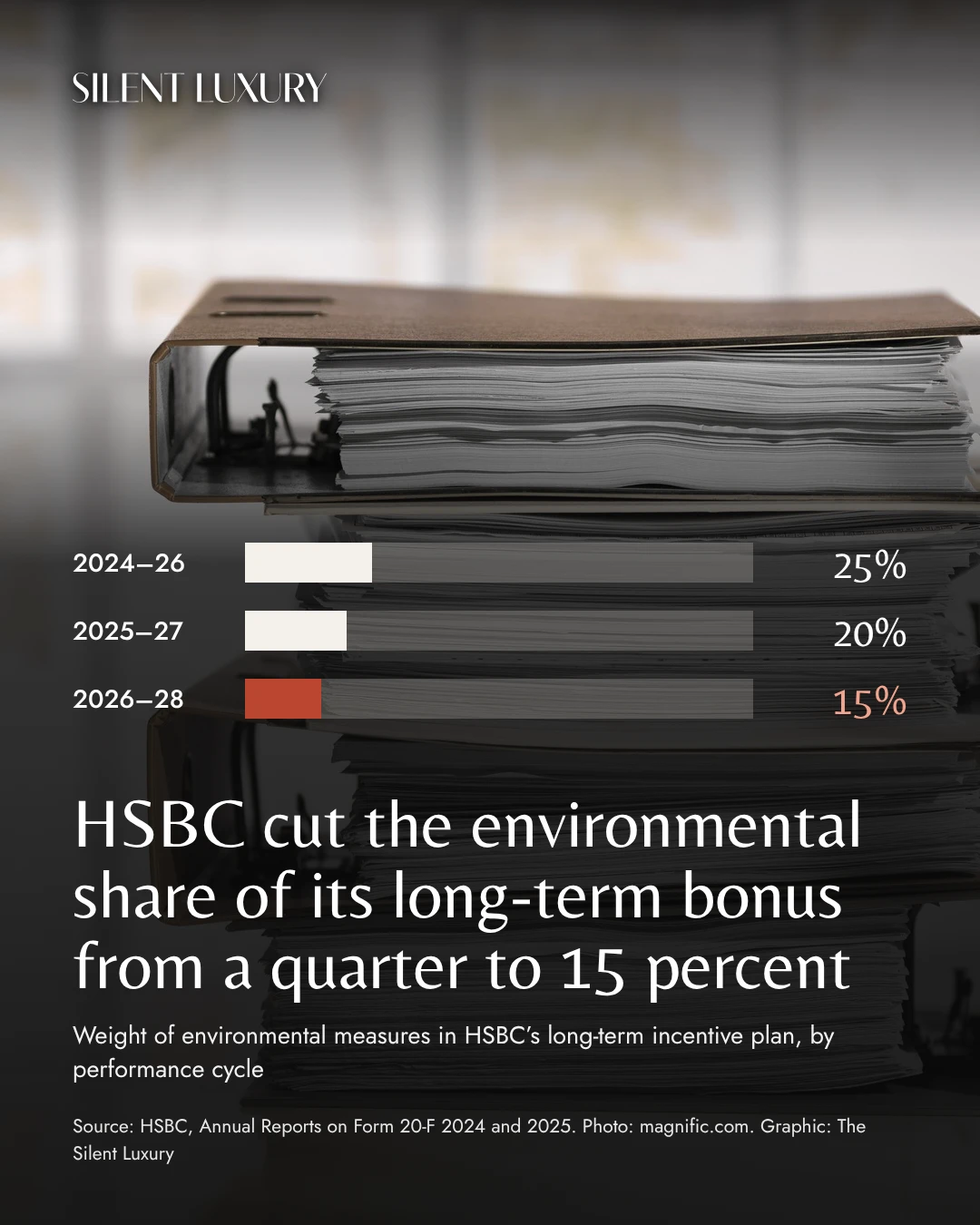
HSBC now aims for net zero in its own operations and supply chain by 2050, twenty years later than before, a change the trade press reported in February 2025. Over three cycles the environmental weight in its long-term plan fell from 25 to 15 percent. In 2024 the BlackRock scorecard listed “sustainable solutions”, a heading that has gone from the 2026 filing, while UBS keeps 12 percent for ESG, unchanged since 2023.
| Company | Climate target today | Pay: before → now | What came in | Source |
|---|---|---|---|---|
| HSBC United Kingdom | Net zero in own operations and supply chain by 2050; 2030 sector targets for financed emissions. FStech (secondary) reported the own-operations date as moved from 2030 in February 2025. | Long-term plan, environmental weight: 25% (2024–26) → 20% (2025–27) → 15% (2026–28). The own-emissions measure was removed, in shareholders’ view “now largely considered business as usual”; sustainable finance 15% → 10%. | A 5% measure checking that financed emissions in oil and gas and in power and utilities stay within internal risk limits; RoTE and relative TSR 42.5% each. | Form 20-F 2025, Directors’ Remuneration Report Form 20-F 2024 26 February 2026 |
| UBS Switzerland | Net zero for Scope 1 and 2 by 2035 (revised in 2024); targets for financed emissions and lending sectors. | Held: two ESG categories of 6% each, 12% of the Group Executive Board scorecard, “unchanged since 2023”. | No new measure. | Annual Report 2025 (Form 20-F), p. 198 9 March 2026 |
| BlackRock United States Partly verified | The 2026 proxy states no separate climate target; it reports a 100% renewable electricity match. BlackRock left the Net Zero Asset Managers initiative on 9 January 2025 (Reuters, secondary). | Scorecard heading “Deliver sustainable solutions to meet client demand” (2024) → absent from the 2026 scorecard. Weight never disclosed; year of the change open. | Headings such as “Grow with our clients’ needs” and “Lead in a changing world”. | DEF 14A 2026, pp. 36, 70, 76 DEF 14A 2024 10 April 2026 |
Technology: Apple, Microsoft, Oracle and Salesforce
Apple’s 2026 proxy statement describes a cash bonus built on net sales and operating income alone. The values modifier that could move it by 10 percent has gone from the text without a reason given. Salesforce removed its ESG metrics “in response to the evolving regulatory environment” and now pays on its AI agents. For fiscal 2027 Microsoft bases the bonus on revenue and operating income, and Oracle pays its head of global field operations partly on orders for GPU capacity.
| Company | Climate target today | Pay: before → now | What came in | Source |
|---|---|---|---|---|
| Microsoft United States | The 2025 proxy cites progress towards carbon negative, waste reduction and water positive goals; the 2026 proxy names none of them. The target itself lies outside this review. | Fiscal 2026: sustainability one indicator within a culture category worth 10% of the CEO bonus → fiscal 2027: revenue and operating income 50% each, individual modifier ±25%; sustainability unnamed. | Infrastructure and capabilities “to lead in the AI era”; performance shares on a “narrower set of strategic growth drivers”. | DEF 14A 2026, pp. 39, 47 DEF 14A 2025, p. 43 21 October 2026 |
| Apple United States | The 2025 proxy cites Apple 2030, carbon neutral across the supply chain and customer device use by the end of the decade; the 2026 proxy leaves it out. The target itself lies outside this review. | Cash bonus with a ±10% values modifier, left unapplied for 2024 because the payout was at its 200% maximum → 2026: net sales and operating income only, modifier absent, reason not stated. | Financial measures only. | DEF 14A 2026, p. 43 DEF 14A 2025, p. 51 8 January 2026 |
| Oracle United States | Not stated in the proxy. | Financial and bookings measures in fiscal 2025 and 2026; the filing records no ESG metric. | Mark Hura, president of global field operations: non-GPU infrastructure bookings 30%, GPU bookings 10%; payout about 122% of target. | DEF 14A 2026 25 September 2026 |
| Salesforce United States | Not stated in the proxy. | Fiscal 2024: ESG 10% of the bonus, of which two sustainability metrics 5 points → fiscal 2025: ESG removed “in response to the evolving regulatory environment”; bonus on financial targets alone. | Performance options on Agentforce and Data Cloud recurring revenue (fiscal 2026); Agentic Work Units and Agentforce & Data 360 recurring revenue, 50% each (fiscal 2027). | DEF 14A 2025, pp. 44, 53 DEF 14A 2024 DEF 14A 2026, p. 37 16 April 2026 |
Consumer Brands: Coca-Cola, Nike, Starbucks and P&G
All four consumer companies in the tracker took sustainability out of executive pay in their plans for 2025 or 2026. At Coca-Cola the sustainability measures “reflected threshold performance or below”, and Starbucks fixed the modifiers on two earlier cycles at a level that “assumes below threshold performance”. The greenhouse gas target Nike set in 2019 is under review, the company says, a review the Science Based Targets initiative requires every five years.
| Company | Climate target today | Pay: before → now | What came in | Source |
|---|---|---|---|---|
| Coca-Cola United States | Voluntary environmental goals with the timeframe extended to 2035 (2025 proxy). | Performance shares 2024: environment 10% (recycled PET, water replenishment) → 2025–27: removed. Sustainability measures for 2023–25 at “threshold performance or below”. Annual bonus 2025: inclusion goals removed. | Revenue, EPS and free cash flow, one third each; “a greater emphasis on core financial outcomes”. | DEF 14A 2026, pp. 47, 56 DEF 14A 2025 16 March 2026 |
| Procter & Gamble United States | Not stated in the 2026 proxy. | ESG Factor, an 80–120% multiplier on the company part of the annual bonus → dropped from fiscal 2025–26, “reflecting the integration” of ESG efforts “into our growth strategy”. | No new measure. | DEF 14A 2026, p. 42 DEF 14A 2025 28 August 2026 |
| Starbucks United States | Not stated in the 2026 proxy. | Fiscal 2024: sustainability goal moved from the bonus into performance units (±10% modifier) → March 2025: modifiers on the 2023 and 2024 units fixed at 0.9 → fiscal 2025: modifier removed. | Comparable store sales 50%, adjusted EPS 50%. | DEF 14A 2026, pp. 43, 53 DEF 14A 2025 26 January 2026 |
| Nike United States | 2030 greenhouse gas target set in 2019: “Currently, we are assessing” it, “consistent with SBTi’s requirement that companies review, recalculate and revalidate targets at least every five years”. | Performance shares 2025–27: “People & Planet” modifier of ±20 points → 2026–28: removed. | Adjusted revenue 50%, adjusted EPS 50%, with a relative TSR modifier; retention awards in December 2025. | DEF 14A 2026, pp. 28, 32, 34, 69 DEF 14A 2025 15 July 2026 |
Luxury: Net Zero Targets and Pay From Burberry to Kering
The net zero target at Burberry moved from the 2039/40 financial year to 2049/50, and Ralph Lauren’s 2026 proxy statement records a swap in pay, with AI metrics in place of citizenship and sustainability metrics in the bonus modifier. Reports that the company dropped a 2040 target come from secondary sources, and the filing is silent on one. On the continent sustainability stays in pay: Hermès keeps 10 percent on CSR criteria and Moncler 15 percent, and Kering keeps climate in its long-term plan alone.
| Company | Climate target today | Pay: before → now | What came in | Source |
|---|---|---|---|---|
| LVMH France Partly verified | LIFE 360 programme; target values not found in the extract reviewed. | CEO annual bonus 2025: CSR and sustainability 30% of the non-financial half, about 15% of variable pay. Long-term plans since October 2022: CSR 15%. Targets “not made public for confidentiality reasons”; prior year outside this review. | No new measure identified. | Universal Registration Document 2025, §2.3 AFG, alert no. 19 1 April 2026 |
| Kering France | SBTi-verified net zero by 2050. | Annual bonus 2025 (François-Henri Pinault): climate 10%, Scope 1–3 cut by 5%, achieved → 2026 (Luca de Meo): no climate criterion. Long-term plan 2026: climate 10%, Scope 1–3 cut by 12% in absolute terms by 2028. | Annual bonus: Brand Equity Index 20%, new organisation 10%. Long-term plan: share of non-cyclical businesses 20%. | 2025 Universal Registration Document, pp. 136, 157, 160 21 April 2026 |
| Hermès France | Not stated in the release. | Held: CSR criterion worth 10% of the executive chairmen’s variable pay; its three indicators were “fully achieved” in 2025. Policy for 2026 proposed for renewal “without any amendments”. | No new measure. | Release on compensation of the executive chairmen 16 February 2026 |
| Moncler Italy | Not stated in the document reviewed. | Annual MBO: ESG 10% and people engagement 5% → 2026: ESG 15%, covering both; the non-financial share stays at 15%. Long-term plan 2026: ESG 15% (preferred yarns and fabrics, renewable power at key suppliers, training). | ESG measures tied to the 2026–28 sustainability plan. | Remuneration Report 2026, pp. 6, 18 20 March 2026 |
| Burberry United Kingdom Partly verified | Net zero target moved from the 2039/40 financial year to 2049/50. | Annual bonus 2025/26: 75% adjusted operating profit, 25% strategic goals that include environmental and social measures without a separate weight; 2026/27: strategic goals tied to Burberry Forward. New 2026 performance share plan on revenue, ROIC and relative TSR, one third each, with no ESG metric. | Revenue, ROIC and relative TSR in the performance share plan. | Annual Report 2025/26 2026 |
| Ralph Lauren United States | Not stated in the 2026 proxy. The Ethos (secondary) reported that the 2040 net zero target was dropped. | Fiscal 2025: ±10% bonus modifier on a citizenship and sustainability scorecard → fiscal 2026: “AI metrics in the form of a scorecard replaced citizenship and sustainability metrics”. Applied at +10% in both years. | AI literacy and enablement metrics in the ±10% modifier. | DEF 14A 2026, pp. 9, 64, 67 DEF 14A 2025 18 June 2026 |
| Prada Italy Partly verified | SBTi-validated targets for Scope 1, 2 and 3; in 2025 the group exceeded its Scope 1 and 2 target. | Long-term cash incentives tied to financial objectives “as well as certain ESG targets”; weights undisclosed. | No new measure identified. | Annual Report 2025 March 2026 |
Hotels: Marriott, Hilton, Accor and IHG
The American hotel groups have softened the language around their climate targets. In 2025 Marriott’s board committee oversaw “science-based emissions reduction targets”, and in 2026 it oversees “sustainability and operational resiliency strategies”. The European groups keep climate in pay as efficiency: Accor measures water use per occupied room, and IHG rewards the adoption of energy conservation measures that help its hotel owners “reduce energy costs”.
| Company | Climate target today | Pay: before → now | What came in | Source |
|---|---|---|---|---|
| Marriott International United States | Committee focus moved from “science-based emissions reduction targets” (2025 proxy) to “sustainability and operational resiliency strategies” (2026 proxy); whether the target stands, the proxy leaves open. | Unchanged: annual bonus on adjusted EBITDA 60% and growth goals 40%; performance shares on adjusted EBITDA with a TSR modifier. Sustainability has no weight. | No new measure. Outside pay, larger sustainability investments go through an analysis that “may include” NPV and IRR. | DEF 14A 2026, pp. 33, 43–44 DEF 14A 2025, p. 34 Supplemental Statement on Sustainability Initiatives 27 March 2026 |
| Accor France | Greenhouse gas cut by the end of 2028 against 2019, for head office, offices and owned or leased hotels, as a pay target; net zero year not stated in the documents. | Held: ESG 15% of the CEO’s annual bonus in 2025 and 2026. 2025 water-intensity target 4%, achieved 5.2%, paid at 136% on this criterion. Long-term plan 2026: greenhouse gas reduction 10%. | An accessibility audit takes the place of women at vice-president level in the people criterion of the 2026 bonus. | Board decisions, 19 March 2026 Board decisions, 18 February 2026 19 March 2026 |
| IHG Hotels & Resorts United Kingdom | Measures “aligned to our decarbonisation strategy”; net zero year not stated in the remuneration report. | Held: long-term plans 2025–27 and 2026–28 give “carbon and people” 10%, of which 5% to energy conservation measures in new-build and conversion hotels. | No new measure. | Directors’ Remuneration Report 2025 25 February 2026 |
| Hilton United States Partly verified | 2025 proxy: “well-defined targets for emissions, water and waste”; 2026 proxy: “creating sustainable stays at our hotels”, with no target values. | Unchanged: “Travel with Purpose” one of several organisational goals in the annual bonus, weight undisclosed; long-term plan without ESG measures. | No new measure. | DEF 14A 2026, pp. 8, 30 DEF 14A 2025, pp. 8, 29 2 April 2026 |
The Pattern: Net Zero Targets and Pay Across 33 Companies
Across the 33 companies, the targets mostly change in their wording, and executive pay changes in substance, differently on each side of the Atlantic. In the United States, sustainability metrics leave executive pay whatever they measure: emissions at Starbucks, packaging and water at Coca-Cola, a values modifier at Apple, ESG factors at Procter & Gamble and Salesforce. British companies trim or move them, as Shell, HSBC and bp cut or shifted weight and Rolls-Royce removed the emissions measure from its long-term plan. In continental Europe, Eni, Holcim, Heidelberg Materials, Safran, Hermès, UBS and Accor keep their weights, Airbus adds a sustainability block, and Kering keeps climate in its long-term plan alone. In France, where Safran, Hermès, Kering and Accor are listed, the Afep-Medef code asks for at least one climate criterion in executive pay, as the explainer on the CSRD Omnibus sets out.
The wider record points the same way. The Net Zero Stocktake 2026, published by Net Zero Tracker on 6 November, finds net zero targets at 64 percent of the listed companies it tracks, and finds that commitments have mostly held their ground. Its first corporate back-tracking analysis looks at how some of the largest companies quietly change their targets. The targets stay on the books; the pay moves.
The weight that leaves goes to money and computing. Revenue, earnings per share and free cash flow take it at Coca-Cola and Nike, and comparable store sales at Starbucks. In fashion and technology some of it goes to artificial intelligence. The bonus modifier at Ralph Lauren now rests on AI metrics, Salesforce ties performance options to its AI agents, and at Oracle a senior executive is paid partly on GPU bookings. Microsoft, which now pays on revenue and operating income, points to the infrastructure it needs “to lead in the AI era”. The same shift runs through the proxy statements in the analysis of ESG executive pay, and back to the investors and regulators in the dossier on the ESG backlash.
Net Zero Targets in Softer Words
The targets bend in their wording. At Delta the goal became an aspiration, Marriott’s committee moved from science-based targets to resiliency strategies, and Hilton’s proxy statement went from “well-defined targets for emissions, water and waste” to “creating sustainable stays”. Elsewhere the dates moved, with Coca-Cola extending its goals to 2035 and Burberry pushing net zero back by a decade.
Efficiency tends to stay. Energy and water efficiency remain in pay at IHG and Accor, and bp keeps measures for the emissions of its own operations. Valero, by contrast, let the modifier tied to its capital for low-carbon fuels expire. Two companies run the other way on their own emissions: HSBC and Rolls-Royce removed those measures, and at HSBC the committee cited shareholders’ view that the work is “now largely considered business as usual”.
The proxy statements filed ahead of the 2027 annual meetings will show where the line moves next.
Send this to someone who sets, or votes on, executive pay.
Continue Reading
-
Ralph Lauren Drops Sustainability From Executive Pay and Rewards AI Instead
Ralph Lauren has replaced the sustainability goals in its executive bonus plan with targets for artificial intelligence, according to its proxy statement for fiscal 2026. The citizenship and sustainability metrics in its short-term incentive plan gave way to an AI scorecard aimed at “AI literacy and enablement”.
-
Luxury Supply Chain ESG: Franco-Italian Framework Sets 46 Shared Requirements
Luxury supply chain ESG now has a shared reference point. The French and Italian fashion chambers have agreed one set of requirements for their suppliers, while each house remains responsible for its own due diligence.
-
Owning Beats Working: AI Wealth and the American Dream on Credit
In 2026 the American economy runs on two engines: corporate investment in artificial intelligence and the spending of its wealthiest households. The four largest hyperscalers plan roughly 725 billion dollars in capital expenditure this year, while the US median household income stands at 83,730 dollars, unchanged in real terms.
Sources
Company documents (original filings, each opened for this tracker): bp, Annual Report and Form 20-F 2025, pp. 94, 109; Shell, Form 20-F 2025, pp. 175–180; Shell, Form 20-F 2024; Eni, Remuneration Report 2026; Eni, Remuneration Report 2025; Valero Energy, DEF 14A 2026, pp. 24–25; Delta Air Lines, DEF 14A 2026, pp. 13, 33; Delta Air Lines, DEF 14A 2025, p. 13; Airbus, 2025 Remuneration Policy; Airbus, AGM 2026 Information Notice; Rolls-Royce Holdings, 2025 Annual Report, pp. 20, 87; Safran, Integrated Report 2025, remuneration policy; Holcim, Compensation Report 2025; Holcim, Compensation Report 2024; Heidelberg Materials, Remuneration Report 2025, pp. 12–13, 15, 20; Vinci, 2025 Universal Registration Document, 4.2.2; Vinci, 5.2.2; HSBC, Form 20-F 2025, Directors’ Remuneration Report; HSBC, Form 20-F 2024; UBS, Annual Report 2025 (Form 20-F), p. 198; BlackRock, DEF 14A 2026, pp. 36, 70, 76; BlackRock, DEF 14A 2024; Microsoft, DEF 14A 2026, pp. 39, 47; Microsoft, DEF 14A 2025, p. 43; Apple, DEF 14A 2026, p. 43; Apple, DEF 14A 2025, p. 51; Oracle, DEF 14A 2026; Salesforce, DEF 14A 2025, pp. 44, 53; Salesforce, DEF 14A 2024; Salesforce, DEF 14A 2026, p. 37; Coca-Cola, DEF 14A 2026, pp. 47, 56; Coca-Cola, DEF 14A 2025; Procter & Gamble, DEF 14A 2026, p. 42; Procter & Gamble, DEF 14A 2025; Starbucks, DEF 14A 2026, pp. 43, 53; Starbucks, DEF 14A 2025; Nike, DEF 14A 2026, pp. 28, 32, 34, 69; Nike, DEF 14A 2025; LVMH, Universal Registration Document 2025, §2.3; LVMH, AFG, alert no. 19; Kering, 2025 Universal Registration Document, pp. 136, 157, 160; Hermès, Release on compensation of the executive chairmen; Moncler, Remuneration Report 2026, pp. 6, 18; Burberry, Annual Report 2025/26; Ralph Lauren, DEF 14A 2026, pp. 9, 64, 67; Ralph Lauren, DEF 14A 2025; Prada, Annual Report 2025; Marriott International, DEF 14A 2026, pp. 33, 43–44; Marriott International, DEF 14A 2025, p. 34; Marriott International, Supplemental Statement on Sustainability Initiatives; Accor, Board decisions, 19 March 2026; Accor, Board decisions, 18 February 2026; IHG Hotels & Resorts, Directors’ Remuneration Report 2025; Hilton, DEF 14A 2026, pp. 8, 30; Hilton, DEF 14A 2025, pp. 8, 29.
Press (secondary sources, marked as such in the tables): FStech on HSBC (20 February 2025); Reuters via Insurance Journal on BlackRock (14 January 2025); The Ethos on Ralph Lauren; ESG Dive on Delta (17 April 2026).
Reference: Net Zero Tracker, Net Zero Stocktake 2026 (6 November 2026).
Status of all entries: 21 November 2026. Secondary sources appear in the tables only where marked as such.
© The Silent Luxury
© The Silent Luxury. You are welcome to quote from this page and to share it, with credit to The Silent Luxury and a link to this page. We are glad to see it travel. Republishing the full text needs our permission, and images remain with their credited owners. Questions are always welcome: eva.winterer@silent-communications.com
Similar Articles

Executive Compensation in 2026: Earnings and AI Replace Climate in the CEO Bonus

Net Zero Asset Managers: BlackRock and Vanguard Quit, and the Alliance Dropped 2050

ESG Meaning: 36 Terms That Explain the Climate Retreat in Plain English