CSRD Omnibus: Nine in Ten Companies Drop Out of EU Sustainability Reporting

In September 2024, Mario Draghi’s report on European competitiveness called the EU’s sustainability reporting framework “a major source of regulatory burden”, and eighteen months later the phrase sat in recital 7 of a directive. Directive (EU) 2026/470, published in the Official Journal on 26 February 2026, amends four laws at once, on audit, accounting, sustainability reporting and corporate due diligence, which is why Brussels calls it an omnibus.
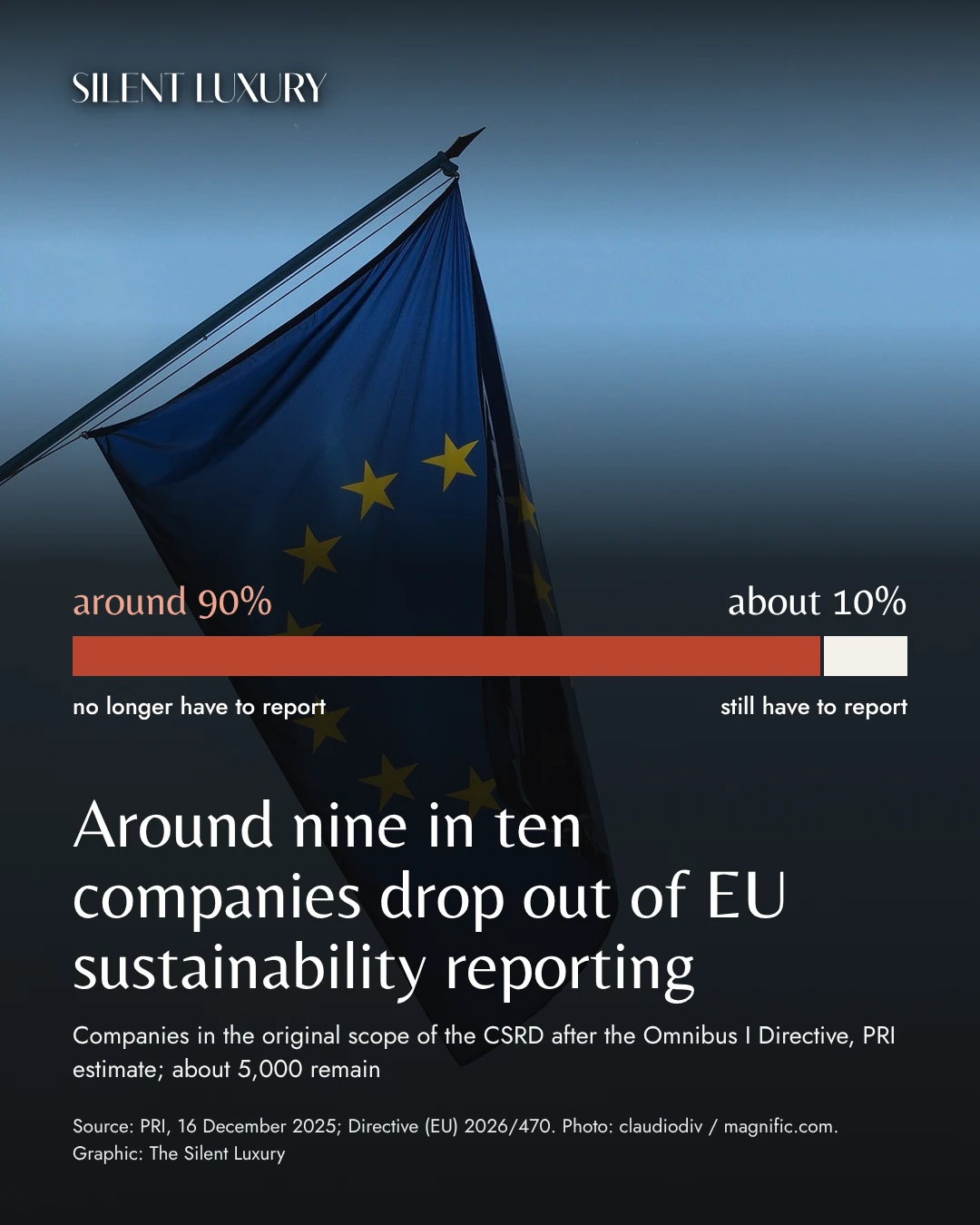
Since it took effect on 18 March 2026, the CSRD Omnibus has sharply cut the number of European companies that must publish a sustainability report, and it has softened the EU’s due diligence law, whose duties now start in July 2029. The PRI, the investor network backed by the United Nations, estimates that around 90 percent of the companies in the original scope fall out of it, which leaves about 5,000.
The product rules arrived in the same year and moved the other way: a ban on destroying unsold clothing and shoes took effect on 19 July 2026, and on 27 September the EU’s ban on vague green claims began to apply. One strand eases what boards must disclose, while the other tightens what companies may claim and throw away. The shift is part of the wider ESG backlash, which in America runs straight into ESG executive pay.
The Law: What the CSRD Omnibus Is, and Why It Is Final
The CSRD Omnibus is final and in force. Its formal name is Directive (EU) 2026/470 of the European Parliament and of the Council of 24 February 2026. It entered into force twenty days after publication, on 18 March, with member states required to write the reporting changes into national law by 19 March 2027 and the due diligence changes by 26 July 2028. The directive’s first recital traces it to a Commission communication of 11 February 2025, whose title set the tone: “A simpler and faster Europe”.
A note from The Silent Luxury
Good reading deserves to find you again.
The Thresholds: Who Must Report Under the CSRD Omnibus
Under the CSRD Omnibus, a company reports only if it exceeds two thresholds in the financial year, net turnover of €450 million and an average of 1,000 employees. Listed small and medium-sized companies drop out, and the Omnibus deletes both the later wave and the reporting standard of their own that the original law had given them.
Groups from outside the EU report if their EU turnover tops €450 million in two consecutive years and they have an EU subsidiary or branch with turnover above €200 million, figures that stood at €150 million and €40 million before the Omnibus. The law orders a review of whether the scope should later extend to large companies below the new thresholds.
| Rule | Who is covered | From when |
|---|---|---|
| CSRD reporting, EU companies | More than 1,000 employees on average and more than €450 million in net turnover | Financial year 2027 for companies new to the regime, while the first wave continues; national law by 19 March 2027 |
| CSRD reporting, groups from outside the EU | EU turnover above €450 million in two consecutive years and an EU subsidiary or branch with turnover above €200 million (before the Omnibus: €150 million and €40 million) | Financial year 2028, in reports published in 2029 |
| Value chain cap | Suppliers with up to 1,000 employees may decline data requests beyond the voluntary standard set in Delegated Regulation (EU) 2026/1560 | Financial years beginning on or after 1 January 2027 |
| Reporting standards (ESRS) | Revised standards cut mandatory datapoints by more than 60 percent | Financial years beginning on or after 1 January 2027 |
| Due diligence (CSDDD) | EU companies with more than 5,000 employees and €1.5 billion in worldwide turnover; non-EU companies with more than €1.5 billion in EU turnover | Duties from 26 July 2029; national law by 26 July 2028 |
| Destruction ban for unsold clothing and footwear (ESPR) | Large companies; medium-sized companies from 19 July 2030 | 19 July 2026 |
| Ban on vague green claims (ECGT) | Traders in their dealings with consumers in the EU | 27 September 2026 |
Source: Directive (EU) 2026/470; Delegated Regulations (EU) 2026/1560 and 2026/1563; Regulation (EU) 2024/1781; Directive (EU) 2024/825; Accountancy Europe.
The Timeline: When CSRD Omnibus Reporting Starts
For large companies new to the regime, reporting starts with the financial year 2027, in reports published in 2028. An earlier directive of 14 April 2025, (EU) 2025/794, known in Brussels as “stop-the-clock”, had already moved the second wave to financial years starting on or after 1 January 2027 and the third wave, listed SMEs, to 2028. The Omnibus has since removed that third wave altogether.
The first wave, which began with the financial year 2024, continues for companies above the new thresholds, and member states may exempt its smaller members for 2025 and 2026.
The reports themselves are getting shorter. On 3 July 2026 the Commission adopted revised European Sustainability Reporting Standards, the ESRS, as Delegated Regulation (EU) 2026/1563, and by its own count they cut mandatory datapoints by more than 60 percent and all datapoints by more than 70 percent. They apply to financial years beginning on or after 1 January 2027, with companies free to choose between the old and the new versions for 2026. Auditors will check the reports to a standard of limited assurance, which the Commission must adopt by 1 July 2027.
The Value Chain Cap: What Suppliers May Refuse Under the CSRD Omnibus
Under the CSRD Omnibus, a supplier with up to 1,000 employees may refuse requests for sustainability data that go beyond a voluntary standard. The law calls such suppliers “protected undertakings” and gives them “the right to decline” anything past that standard. A reporting company may impose nothing further through a contract, and a self-declaration by the supplier is enough. A company that asks only for data within the standard counts as compliant, and for its first three reporting years it may explain gaps in its value chain data by setting out its efforts, its reasons and its plans.
The voluntary standard began life as a recommendation, issued by the Commission on 30 July 2025 as Recommendation (EU) 2025/1710 and known as the VSME. The Omnibus required a delegated act by 19 July 2026. Delegated Regulation (EU) 2026/1560 of 3 July 2026 was published on 21 September, with a basic module of eleven disclosures and a comprehensive module of nine. The cap covers the datapoints in its Annex II, and the article that sets it applies to financial years beginning on or after 1 January 2027.
The figure of 1,000 employees therefore marks two lines: above it, with €450 million in turnover, a company must report, and below it a supplier may say no.
The Due Diligence Rules: The CSDDD and the Taxonomy
The Omnibus narrows the Corporate Sustainability Due Diligence Directive, the CSDDD, to the largest companies and pushes its start to 2029. It now covers EU companies with more than 5,000 employees on average and net worldwide turnover above €1.5 billion, and non-EU companies with more than €1.5 billion of turnover in the EU. The obligations apply from 26 July 2029 and reporting under the directive starts with financial years from 1 January 2030, a year later than the largest group would have started under stop-the-clock.
Article 22, the duty to adopt a climate transition plan, is deleted, and recital 47 explains that such provisions “have been deemed to be disproportionate”, although a company that has a plan still discloses it under the CSRD. The EU-wide civil liability rule goes as well. Liability now follows national law, victims keep “a right to full compensation”, punitive damages are excluded, and fines are capped “at 3 % of the net worldwide turnover”. Companies may ask partners with fewer than 5,000 employees for information only when it cannot be obtained another way.
The fashion federations of Paris and Milan went ahead on their own. In May 2026 FHCM and CNMI published a voluntary framework of 46 shared supply-chain requirements, meant to give the workshops that supply luxury one set of audits.
The Taxonomy
The EU taxonomy, the classification of green economic activities, was trimmed by a separate act. Since 1 January 2026, Delegated Regulation (EU) 2026/73 has eased the taxonomy for non-financial companies, which may skip activities that together account for less than 10 percent of turnover, capital or operating expenditure. In the regulation’s own words, the reporting templates “should be significantly shortened and simplified”.
The Other Route: The ECGT Applies, the Green Claims Directive Leaves
Europe’s rules on green claims took the opposite path from its reporting rules. The Empowering Consumers for the Green Transition Directive, Directive (EU) 2024/825, has applied since 27 September 2026. It outlaws vague environmental claims without proof of excellent performance, sustainability labels backed by neither a certification scheme nor a public authority, and carbon-neutral claims that rest on offsets.
The Green Claims Directive was meant to set rules for how explicit environmental claims are substantiated and communicated. The Commission proposed it in 2023 as COM(2023) 166, and on 4 November 2026 it put the proposal on the withdrawal list of its 2027 work programme: the file had been “pending with co-legislators more than three years”, and the Council had reached no negotiating mandate. The withdrawal takes formal effect once it is published in the Official Journal. Companies now face the bans of the first directive without the proof procedure of the second.
Unsold Goods, Textile Waste and the Product Passport
The Ecodesign for Sustainable Products Regulation, Regulation (EU) 2024/1781, defines destruction as “the intentional damaging or discarding of a product as waste”, and since 19 July 2026 its Article 25 has banned large companies from destroying unsold clothing and footwear listed in Annex VII. Medium-sized companies follow on 19 July 2030, while micro and small ones are exempt.
Directive (EU) 2025/1892, in force since 16 October 2025, brings extended producer responsibility to textiles. Member states transpose it by 17 June 2027, and schemes for textiles and footwear must be in place by 17 April 2028. The producer is whoever first makes the goods available in a member state under its own name or brand, so the cost of fashion’s waste falls on whoever puts its name on the label. The Digital Product Passport, a set of data specific to each product, comes last: the Commission plans the delegated act for textiles for the fourth quarter of 2027, and the date it will apply is still open.
The Exception: What the EUDR Leather Exemption Covers
Leather left the deforestation rules before they started. The EU Deforestation Regulation, Regulation (EU) 2023/1115, admits covered goods to the EU market only if they are deforestation-free, produced in line with the laws of the country of production and covered by a due diligence statement, with a cut-off date of 31 December 2020. Under Regulation (EU) 2025/2650 its obligations start on 30 December 2026, and micro and small enterprises established as such by 31 December 2024 follow on 30 June 2027.
On 13 July 2026 the Commission adopted Delegated Regulation (EU) 2026/2102, which strikes cattle hides, skins and bovine leather from Annex I. It was published on 17 September and entered into force the next day, more than three months before the obligations begin. The same update also removes retreaded tyres and seats for aircraft and motor vehicles and, from 30 December 2027, adds soluble coffee, certain palm oil derivatives and frozen bovine tongues. Hides and leather are left to the general review of the deforestation rules due in 2030.
The Boardroom: Afep-Medef and the Climate Criterion in French Pay
French boardrooms have kept climate in executive pay. The Haut Comité de Gouvernement d’Entreprise, which monitors the Afep-Medef code, found in its 2025 report that 89 percent of companies in the SBF 120 had built a climate criterion into annual or long-term variable pay for 2024. Section 26.1.1 of the code asks for at least one such criterion, on a comply-or-explain basis.
What Comes Next Under the CSRD Omnibus
The next dates are fixed. National reporting laws are due by March 2027, and the first reports under the new thresholds cover the year 2027. Producer responsibility schemes follow by April 2028 and due diligence duties in July 2029, and in 2030 the Commission takes a fresh look at leather.
Send this to someone who reports under the CSRD, or used to.
Continue Reading
-
Net Zero Asset Managers: BlackRock and Vanguard Left, and the Pledge Lost Its 2050 Date
The Net Zero Asset Managers initiative is a voluntary alliance of fund managers. Vanguard left in 2022 and BlackRock in 2025, and the initiative relaunched in February 2026 with more than 250 managers and an undated goal.
-
Net Zero Target Tracker: 33 Companies, Their Climate Targets and Their Pay
The net zero target tracker follows 33 companies in eight industries, from bp and HSBC to Apple, Kering and Marriott, and records the climate target each states and what its executives are now paid for.
-
Ralph Lauren Drops Sustainability From Executive Pay and Rewards AI Instead
Ralph Lauren has replaced the sustainability goals in its executive bonus plan with targets for artificial intelligence, according to its proxy statement for fiscal 2026. Environmental and social goals had been part of the bonus since fiscal 2022.
Sources
EU law (EUR-Lex, Official Journal): Directive (EU) 2026/470 (Omnibus I); Directive (EU) 2026/470, full text; Directive (EU) 2025/794 (stop-the-clock); Commission Recommendation (EU) 2025/1710 (VSME); Delegated Regulation (EU) 2026/1560 (voluntary standard); Delegated Regulation (EU) 2026/1563 (ESRS); Delegated Regulation (EU) 2026/73 (taxonomy); Directive (EU) 2024/825 (ECGT); Proposal COM(2023) 166 (Green Claims); Regulation (EU) 2024/1781 (ESPR); Directive (EU) 2025/1892 (Waste Framework, textiles); Regulation (EU) 2023/1115 (EUDR); Regulation (EU) 2025/2650 (EUDR application); Delegated Regulation (EU) 2026/2102 (EUDR, leather).
European Commission and Council: revised sustainability reporting standards (3 July 2026); destruction of unsold clothes and shoes (9 February 2026); revised Waste Framework Directive enters into force; Digital Product Passport for textiles; Access2Markets on the EUDR timetable; EUDR product scope update (13 July 2026); Commission Work Programme 2027, Annex III, entry 4, COM(2026) 710 (4 November 2026).
France: Haut Comité de Gouvernement d’Entreprise, Rapport 2025; Afep-Medef Corporate Governance Code, December 2022, section 26.1.1 (ECGI).
Analyses, law firms and press: PRI on the final Omnibus agreement (16 December 2025); Linklaters on Omnibus I; Latham & Watkins on Omnibus I; ESG Today on the Green Claims withdrawal (4 November 2026).
© The Silent Luxury
© The Silent Luxury. You are welcome to quote from this article and to share it, with credit to The Silent Luxury and a link to this page. We are glad to see it travel. Republishing the full text needs our permission, and images remain with their credited owners. Questions are always welcome: eva.winterer@silent-communications.com
Similar Articles

Executive Compensation in 2026: Earnings and AI Replace Climate in the CEO Bonus

Net Zero Asset Managers: BlackRock and Vanguard Quit, and the Alliance Dropped 2050

ESG Meaning: 36 Terms That Explain the Climate Retreat in Plain English