Net Zero Asset Managers: BlackRock and Vanguard Quit, and the Alliance Dropped 2050

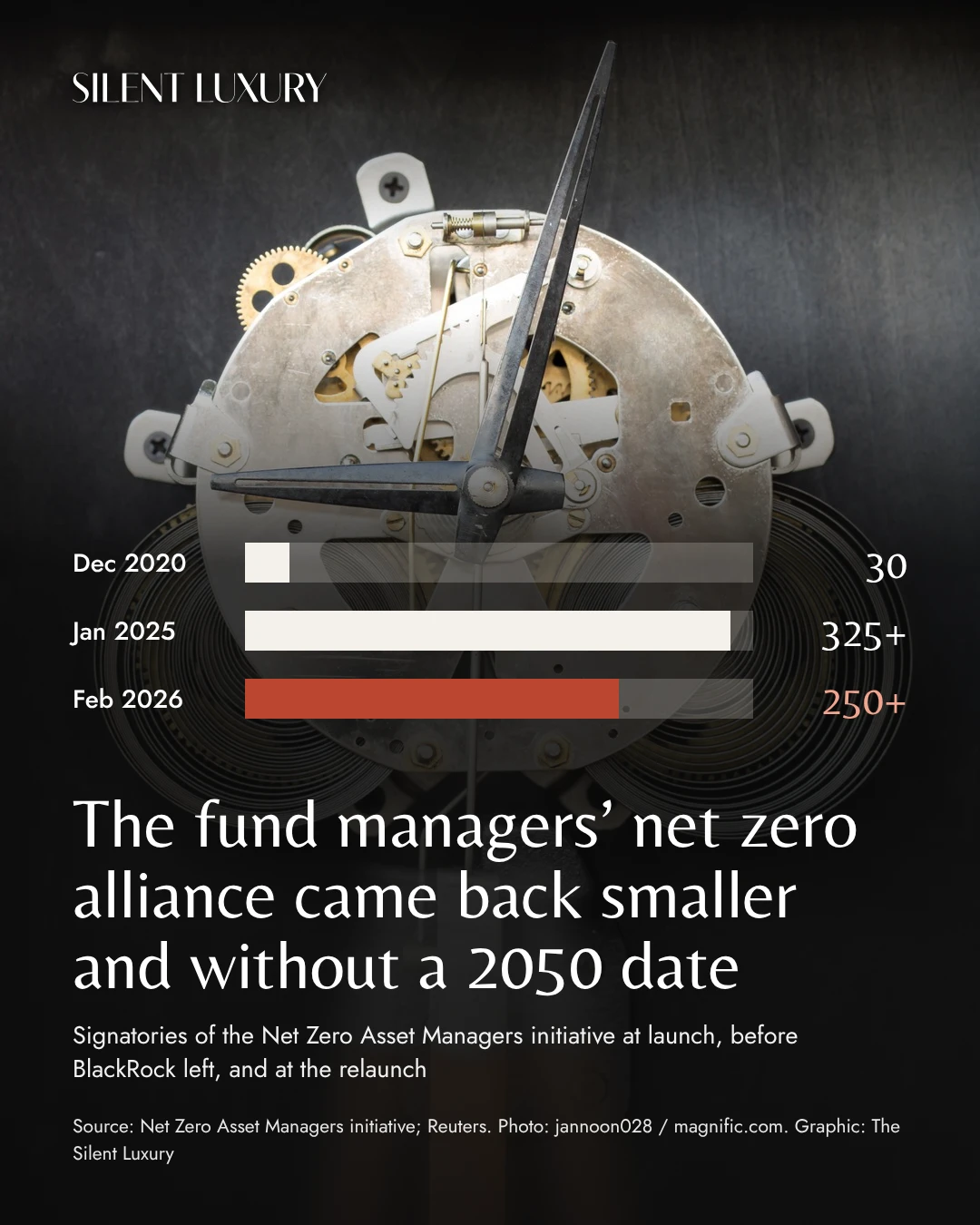
In December 2020 the thirty founding members of the Net Zero Asset Managers initiative promised net zero by 2050 across their portfolios. When the alliance returned on 25 February 2026, after a pause of more than a year, the date had gone, and the new promise arrived with its conditions written in. Welcoming the relaunch, Takeshi Wada of Sumitomo Mitsui Trust Asset Management said his firm looked forward to supporting clients “to deliver on their climate goals where consistent with our fiduciary duties and, where applicable, client mandates, fund investment objectives and other legal obligations”. He was repeating the caveat of the new commitment, word for word.
The new text commits its signatories to “support investing aligned with the global goal of net zero greenhouse gas emissions”. The two large American managers that left have stayed out. Vanguard, the first to go, settled an antitrust suit brought by Texas and, by then, twelve other states in February 2026. BlackRock has been out since 9 January 2025.
The exits reach into executive pay. The same fund managers cast the largest blocks of votes at American annual meetings, the votes on pay among them. Since late 2024, state attorneys general, a federal court and the Securities and Exchange Commission have attached legal risk to using those votes for climate goals. The pressure is part of the wider ESG backlash, and the proxy statements show where it lands in ESG executive pay.
The alliance in six dates
- 11 December 2020: thirty fund managers with about $9 trillion under management launch the Net Zero Asset Managers initiative and promise net zero by 2050.
- 7 December 2022: Vanguard leaves.
- 27 November 2024: Texas and ten other states sue BlackRock, State Street and Vanguard in federal court.
- 9 January 2025: BlackRock leaves; four days later the initiative pauses.
- 11 February 2025: SEC staff narrow what an investor holding more than 5 percent of a company may press for and still file the short Schedule 13G.
- 25 February 2026: the initiative relaunches with more than 250 managers and no 2050 date; a day later the court dismisses the claims against Vanguard, which, according to the Alabama attorney general, pays $29.5 million and denies any wrongdoing.
The Owners: How Much BlackRock Owns, and Why Its Vote Counts
In early 2025 BlackRock managed some $11.5 trillion, and with Vanguard and State Street it forms the Big Three of index investing, which by a 2017 count were together the largest shareholder in 88 percent of S&P 500 companies, according to a study by Jan Fichtner, Eelke Heemskerk and Javier Garcia-Bernardo. On data from the same year, Lucian Bebchuk and Scott Hirst put the three’s average combined stake at more than 20 percent, and in director elections in 2018 they cast about a quarter of all votes.
Their influence runs through the ballot and the meeting room. The industry calls this stewardship, and Britain’s Financial Reporting Council defines it as “the responsible allocation, management and oversight of capital” for clients and beneficiaries, with voting and engagement among the principles of its code.
The ballot arrives with the proxy statement, which an American listed company files with the SEC before its annual meeting under Section 14(a) of the Securities Exchange Act of 1934, and whose final version appears in the SEC’s database as DEF 14A. Since 2011 shareholders have also voted on executive pay at least once every three years, and that advisory vote, Say on Pay, gives the largest holders the loudest voice on bonuses.
A note from The Silent Luxury
Good reading deserves to find you again.
The Pledge: What the Net Zero Asset Managers Initiative Promised
The Net Zero Asset Managers initiative is a voluntary pledge by fund managers to invest in line with net zero emissions. It launched on 11 December 2020 with 30 managers and about $9 trillion, and by July 2024 it had more than 325 signatories, whose assets Reuters put at more than $57 trillion in January 2025.
The banks built an alliance of their own. In April 2021, 43 of them formed the Net-Zero Banking Alliance under the UN Environment Programme’s finance initiative. They pledged to bring their portfolios to “net-zero by 2050 or sooner”, and by October 2024 the alliance had 144 members. That same April the UN climate secretariat announced the Glasgow Financial Alliance for Net Zero, GFANZ, chaired by Mark Carney, then a UN special envoy, and it gathered more than 160 firms with about $70 trillion. Alongside them, Climate Action 100+, backed by hundreds of investors, aimed at the companies themselves: 170 of the world’s largest corporate emitters.
The Exits: When Vanguard and BlackRock Left Net Zero Asset Managers
The first exit came on 7 December 2022, when Vanguard left the Net Zero Asset Managers initiative so that it could “provide the clarity our investors desire”, and over the next two years the departures spread to the other alliances. In February 2024, Climate Action 100+ reported the withdrawal of J.P. Morgan Asset Management, State Street Global Advisors and PIMCO, while BlackRock moved its participation to BlackRock International. Six large American banks, JPMorgan and Goldman Sachs among them, left the banking alliance between late December 2024 and early January 2025, and BlackRock left the asset managers on 9 January.
Why the Initiative Paused
Four days after BlackRock’s exit, on 13 January 2025, the initiative opened a review, citing developments in the United States and differing expectations among regulators and clients, and it suspended its tracking of how signatories implemented and reported on their commitments.
The banking alliance went further. On 27 August 2025 its steering group asked members to replace the membership model with a looser framework, and on 3 October the members voted “to immediately cease operations”, by which time GFANZ had already announced, on 2 January 2025, that it would become an independent group of chief executives and senior finance figures.
The Legal Risk: Why BlackRock Left
According to Reuters, BlackRock gave two reasons for leaving: confusion about its climate work, and legal inquiries. Its statement named no case. Six weeks earlier, Texas and ten other states had sued it.
Ken Paxton, the Texas attorney general, filed the suit on 27 November 2024 in federal court in the Eastern District of Texas, against BlackRock, State Street and Vanguard. The complaint accuses the three of “conspiring to artificially constrict the market for coal through anticompetitive trade practices” and cites Climate Action 100+ and the Net Zero Asset Managers initiative as signals of that conspiracy.
The Aftermath: The SEC, the Court in Texas and Vanguard’s Settlement
In the year after BlackRock left, the SEC narrowed the room for investor pressure. The court in Texas let the core of the suit proceed, and Vanguard settled.
The SEC’s New Line
On 11 February 2025, a month after BlackRock’s exit, SEC staff redrew the line between engagement and control. An investor with more than 5 percent of a company’s shares may file the short Schedule 13G for as long as it stays passive. Interpretation 103.12, issued that day, sets out where passivity ends: an investor that “exerts pressure on management to implement specific measures or changes to a policy” may lose the short form. Among the staff’s examples are pressing a company to “change its executive compensation practices” or to act on environmental policy, and the same applies when the investor makes its support for the company’s director nominees depend on it.
A day later, Staff Legal Bulletin 14M withdrew its predecessor and restored a company-by-company test for shareholder proposals. Among its examples of micromanagement, the SEC cited a proposal asking for a net zero plan by 2030.
The Texas Case
The Texas case gained two states before it lost a defendant. An amended complaint of 16 January 2025 brought in Louisiana and Oklahoma, for thirteen states in all, and on 1 August 2025 the court let the core of the case go forward, with claims under Section 7 of the Clayton Act and Section 1 of the Sherman Act. The safe harbour for passive investors, the court held, stops short of shareholders who use proxy voting or engagement to reduce competition. It dismissed Louisiana’s consumer-protection claim and two of Nebraska’s three, and its ruling decided only that the remaining claims could proceed to proof.
Vanguard was the first defendant to settle. On 26 February 2026 the court dismissed the claims against Vanguard with prejudice, and according to the Alabama attorney general the manager pays $29.5 million and agrees to refrain from steering companies’ business strategies through its holdings, from nominating directors and from filing shareholder proposals. It must also offer proxy-voting choice in funds that hold at least half of its US equity fund assets, a duty the law firm Ropes & Gray dates to June 2027, noting that Vanguard denies any wrongdoing. All thirteen states signed, while BlackRock and State Street are contesting the case, which remained open at the end of October 2026, according to the Sabin Center’s Climate Case Chart.
The Relaunch: What the New Net Zero Asset Managers Commitment Says
The new commitment supports net zero within the limits of each manager’s duties to its clients. The initiative relaunched on 25 February 2026 after a six-month strategic review, and its core sentence commits signatories to “support investing aligned with the global goal of net zero greenhouse gas emissions”. The pledge holds “where consistent with our fiduciary duties” and, where applicable, with “client mandates, fund investment objectives and other legal obligations”.
The list of actions shrank from ten to seven. Signatories inform their clients and support the clients’ own climate goals, “set near-term climate targets consistent with the global goal of net zero”, keep a stewardship strategy on material climate risks and engage index providers, data firms and rating agencies. Their lobbying must stay consistent with the goals, and each publishes an implementation plan and an annual report, or in the initiative’s own words, “Signatories independently set targets, develop their own strategies, and report annually.”
Targets that signatories disclosed before the pause remain valid, the initiative said, unless a signatory asks for a review. ESG Dive reported that the references to net zero by 2050 had been removed from the commitment. BlackRock stays outside, while State Street, its co-defendant in Texas, appears on the signatory list through its European legal entities.
The Asset Owners: The Pension Funds Behind Net Zero Asset Managers
Pension funds in northern Europe and Britain form the core of the owners behind the initiative. An Asset Owner Statement led by Brunel Pension Partnership, a British pension pool, had 53 signatories by 19 February 2026, together holding $3.7 trillion, among them Sweden’s AP2, AP3 and AP7, Denmark’s AkademikerPension, Norway’s Storebrand and the Church of Sweden.
In the Netherlands, APG managed €601 billion for Dutch pension funds, including ABP, at the end of 2025. It was a founding signatory of the initiative and remains one. Its climate transition plan of June 2026 commits to net zero across the whole portfolio by 2050 and aims by 2030 to halve absolute financed emissions from 2019 levels, across Scope 1 to 3. Since 2018 it has worked inside Climate Action 100+ as a lead engager.
Norway’s sovereign wealth fund goes its own way. In October 2025 Norges Bank Investment Management, which runs it, published a climate action plan for 2030 that aims to “support an orderly transition to net zero emissions by 2050”, and it engages companies on “credible climate targets and transition plans” on its own account.
The Bonus: What the Net Zero Retreat Means for Executive Pay
The new rules make it costlier for the largest shareholders to press for climate targets in executive pay. Say on Pay gives every shareholder a vote on pay at least every three years, and the largest holders the heaviest one. Under Interpretation 103.12, an investor that presses for a change in executive pay can lose its short filing when it ties its votes for directors to the change, and Vanguard’s settlement adds a contractual line against steering strategy through its shares.
The order of events is on the record. The climate line in the bonus lost its most powerful advocates first, and then it began to leave American proxy statements. In fashion, Ralph Lauren replaced the sustainability goals in its executive bonus with targets for artificial intelligence. In Europe, the CSRD Omnibus has cut the reporting duty, while the rules for products and their green claims have grown stricter.
Whether the owners will press for climate targets in the bonus is a question the 2027 proxy season begins to answer. At APG and at Norway’s fund the plans still run to 2050, and the date that left the managers’ pledge lives on in the owners’ plans.
Send this to someone whose fund once signed a net zero pledge.
Continue Reading
-
Net Zero Target Tracker: 33 Companies, Their Climate Targets and Their Pay
The net zero target tracker follows 33 companies in eight industries, from bp and HSBC to Apple, Kering and Marriott, and records the climate target each states and what its executives are now paid for.
-
Luxury Supply Chain ESG: Franco-Italian Framework Sets 46 Shared Requirements
The Fédération de la Haute Couture et de la Mode and the Camera Nazionale della Moda Italiana published a shared ESG harmonisation framework on 13 May 2026. The voluntary document sets out 46 requirements across governance, health and safety, human rights and labour conditions, and environmental compliance.
-
The Luxury Economy at a Turning Point: What 2026 Revealed
The luxury industry ended 2026 at about the same size, with its growth gathered among clients who already buy and in goods that hold their value. Ownership of the chain, from the mine and the workshop to resale, is the question that will shape 2027.
Sources
Studies: Fichtner, Heemskerk and Garcia-Bernardo, “Hidden power of the Big Three?”, Business and Politics (2017); Bebchuk and Hirst, “The Specter of the Giant Three”, Harvard Law School Forum (21 May 2019); Boston University Law Review, full text.
Regulators and courts: Financial Reporting Council, UK Stewardship Code 2026; SEC Investor.gov, proxy statements; SEC Press Release 2011-25, Say on Pay (25 January 2011); SEC Investor.gov, Schedules 13D and 13G; SEC, C&DI 103.12 (11 February 2025); SEC, Staff Legal Bulletin No. 14M (12 February 2025); Texas Attorney General (27 November 2024); US District Court, Eastern District of Texas, Memorandum Opinion and Order, 6:24-cv-00437, Dkt. 113 (1 August 2025); Stipulated Order of Dismissal of Vanguard, Dkt. 147 (26 February 2026); Alabama Attorney General (2 March 2026).
Alliances: Net Zero Asset Managers, news; Net Zero Asset Managers, relaunch (25 February 2026); Net Zero Asset Managers, commitment; Net Zero Asset Managers, signatories; Asset Owner Statement led by Brunel Pension Partnership; UNEP FI, launch of the Net-Zero Banking Alliance (21 April 2021); UNEP FI, NZBA 2024 progress update; UNEP FI, NZBA update (August 2025); UNFCCC on the launch of GFANZ (21 April 2021); GFANZ, restructuring (2 January 2025); Climate Action 100+, reaction to recent departures (26 February 2024).
Asset owners: APG Asset Management, Climate Transition Plan (3 June 2026); APG, announcement; Norges Bank Investment Management, new climate action plan (22 October 2025); NBIM, 2030 Climate Action Plan.
Press and law firms: Reuters via Al Jazeera (7 December 2022); BusinessGreen on Vanguard; Reuters via Insurance Journal (14 January 2025); ESG Today (14 January 2025); ESG Dive on the NZAM relaunch; Banking Dive on the NZBA; ESG Dive on the NZBA; Ropes & Gray on the Vanguard settlement (March 2026); Sabin Center, Climate Case Chart, Texas v. BlackRock (secondary source, status of the case).
© The Silent Luxury
© The Silent Luxury. You are welcome to quote from this article and to share it, with credit to The Silent Luxury and a link to this page. We are glad to see it travel. Republishing the full text needs our permission, and images remain with their credited owners. Questions are always welcome: eva.winterer@silent-communications.com
Similar Articles

Executive Compensation in 2026: Earnings and AI Replace Climate in the CEO Bonus

ESG Meaning: 36 Terms That Explain the Climate Retreat in Plain English

The ESG Backlash: Big Companies Are Dropping Carbon Targets From CEO Pay