Executive Compensation in 2026: Earnings and AI Replace Climate in the CEO Bonus

It took a single sentence to close eleven years of climate pay at Verizon. In the proxy statement it filed in 2026, the compensation committee reported that it had “replaced the responsible business metrics” in the annual bonus with “qualitative strategic and culture goals” of “the same weighting”. The responsible business metrics were three measures that had rewarded the company’s executives for cutting carbon, for workforce diversity and for spending with diverse suppliers. Wireless service revenue, operating income and operating cash flow stayed exactly where they were. The carbon metric had first entered the bonus in 2014, six years before Larry Fink told the chief executives of the companies BlackRock invests in, in a letter headed “A Fundamental Reshaping of Finance”, that climate risk was investment risk.
Across the S&P 500 that sentence has dozens of counterparts. By 2023, almost one in three of its companies tied executive pay to carbon emissions. When Bloomberg published this year’s figure on 18 November 2026, drawn from Conference Board and ESGAUGE data, it stood at 17.7 percent. ESG executive pay, the practice of tying what executives earn to environmental, social and governance targets, is in retreat across American boardrooms. What remains of it follows a logic that several filings spell out with unusual frankness: sustainability is judged like any other investment. In the bonus, climate stays where it pays for itself within the bonus’s own horizon. Call it net present virtue: sustainability that has to show a return on the same terms as a new refinery unit or a data centre, or leave the plan. Sustainability is losing its value in the boardroom, and the proxy statements record the price at which it is still bought.
The Promise: Climate Entered the Bonus as the Owners Signed Up to Net Zero
The climate line in executive pay spread in the same years in which the largest owners of American companies made promises of their own. On 11 December 2020, thirty fund managers with about $9 trillion under management launched the Net Zero Asset Managers initiative, and by January 2025 it counted more than 325 signatories managing more than $57 trillion. In April 2021, 43 of the world’s largest banks formed the Net-Zero Banking Alliance and pledged to bring their portfolios to net zero by 2050 or sooner. The boards on the other side of those portfolios wrote targets into pay. In 2021 Apple added a modifier to its cash bonus, tied in its own words to the company’s “values and key community initiatives” and able to move the payout by 10 percent either way. The refiner Valero wrote an Energy Transition Modifier into the performance shares it granted from 2021 to 2024. In 2023 the share of S&P 500 companies with a carbon line in executive pay reached 30 percent, the high point in the Conference Board’s data.
What these pledges shared was a clock. The fund managers and the banks promised net zero by 2050, a date three decades away, and the bonus was the place where that distant date met the one- to three-year horizon on which executives are paid.
A note from The Silent Luxury
Good reading deserves to find you again.
The Reversal: The Long Clock Lost Its Keepers
The largest American keepers of the long clock left within a few weeks at the turn of 2025. Between late December 2024 and early January 2025, before Donald Trump took office, JPMorgan, Bank of America, Citi, Wells Fargo, Goldman Sachs and Morgan Stanley all left the Net-Zero Banking Alliance. On 9 January BlackRock, by then managing some $11.5 trillion, left the asset managers’ initiative that Vanguard had already quit in December 2022. Eleven days later, on the day of his inauguration, the president signed an executive order titled “Unleashing American Energy”.
The regulators changed the terms on which an investor may press a company. On 11 February 2025, staff at the Securities and Exchange Commission issued an interpretation under which an investor that pushes for “specific actions on a social, environmental, or political policy” and ties its votes for directors to them can lose its passive status. With it goes the short form on which the largest index funds report their holdings. On 27 March the Commission voted to stop defending its own climate disclosure rules, which Mark T. Uyeda, the acting chairman, called “costly and unnecessarily intrusive”. A lawsuit had been running since November 2024, when Texas and ten other states sued BlackRock, State Street and Vanguard over an alleged conspiracy to constrict the coal market. In February 2026 Vanguard settled for $29.5 million and agreed to refrain from using its holdings to steer the strategies of the companies it owns, while denying any wrongdoing.
Shareholders drew back in the same seasons. Environmental and social proposals fell by almost 40 percent in the 2025 proxy year, according to Morningstar researchers writing on the Harvard Law School Forum on Corporate Governance, and average support dropped to 13 percent, against a peak of 33 percent in 2021. The wider ESG backlash had reached the ballot. The alliances were then wound up or rebuilt. The banking alliance voted to close on 3 October 2025, and the Net Zero Asset Managers initiative returned on 25 February 2026 with more than 250 managers and a commitment from which the references to net zero by 2050 had gone.
Governments failed to agree as well. The COP31 climate talks in Antalya were due to close on 20 November 2026 and ran more than 44 hours over. They ended on 22 November without a cover decision, the summit’s main political text. The European Union, Panama, Norway and small island states such as Vanuatu and the Marshall Islands had refused a final draft that named neither coal, oil nor gas. The Alliance of Small Island States said the draft fell short of the scale of the crisis, and that for its members the stakes remain existential.
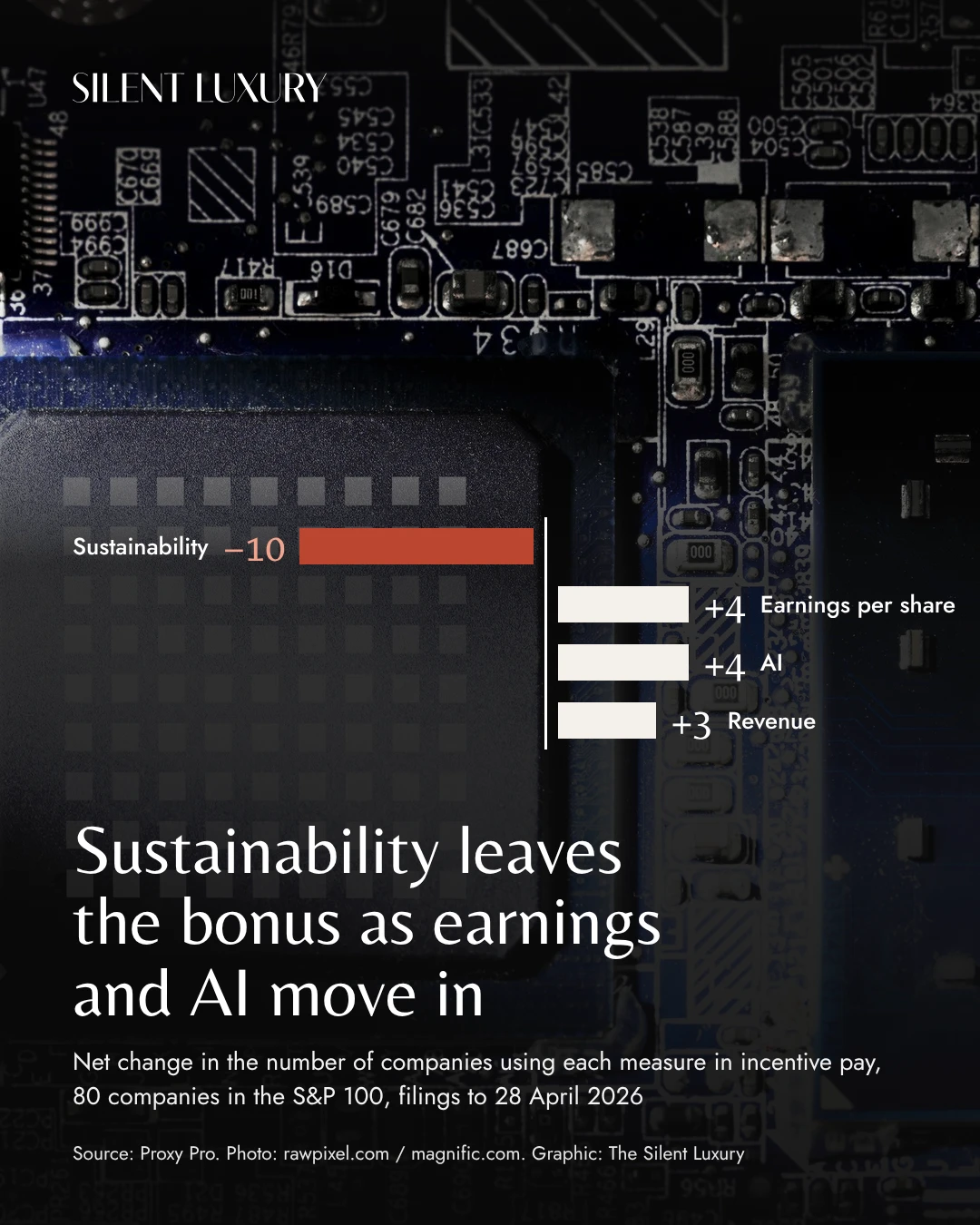
Inside the companies, the filings of 2025 and 2026 moved the weight with little ceremony, towards earnings, revenue and artificial intelligence. A study of 80 companies in the S&P 100 by Proxy Pro found sustainability to be the category most often removed from incentive pay, while earnings per share and measures for artificial intelligence each gained a net four companies. “We eliminated the non-financial component of our AIP design,” RTX wrote, moving “100% of weighting to financial performance”, split equally between earnings and free cash flow. For fiscal 2027 Microsoft will base the cash bonus “solely on Company metrics, with an individual modifier”, and it points to the infrastructure it needs “to lead in the AI era”. At Oracle, Mark Hura, president of global field operations, earned 122 percent of his target bonus, and two of his five measures were orders for computing capacity, GPU bookings among them. In fashion, Ralph Lauren made the swap in a single line: “AI metrics in the form of a scorecard replaced citizenship and sustainability metrics”.
The Small Print: How Little ESG Executive Pay Was Worth
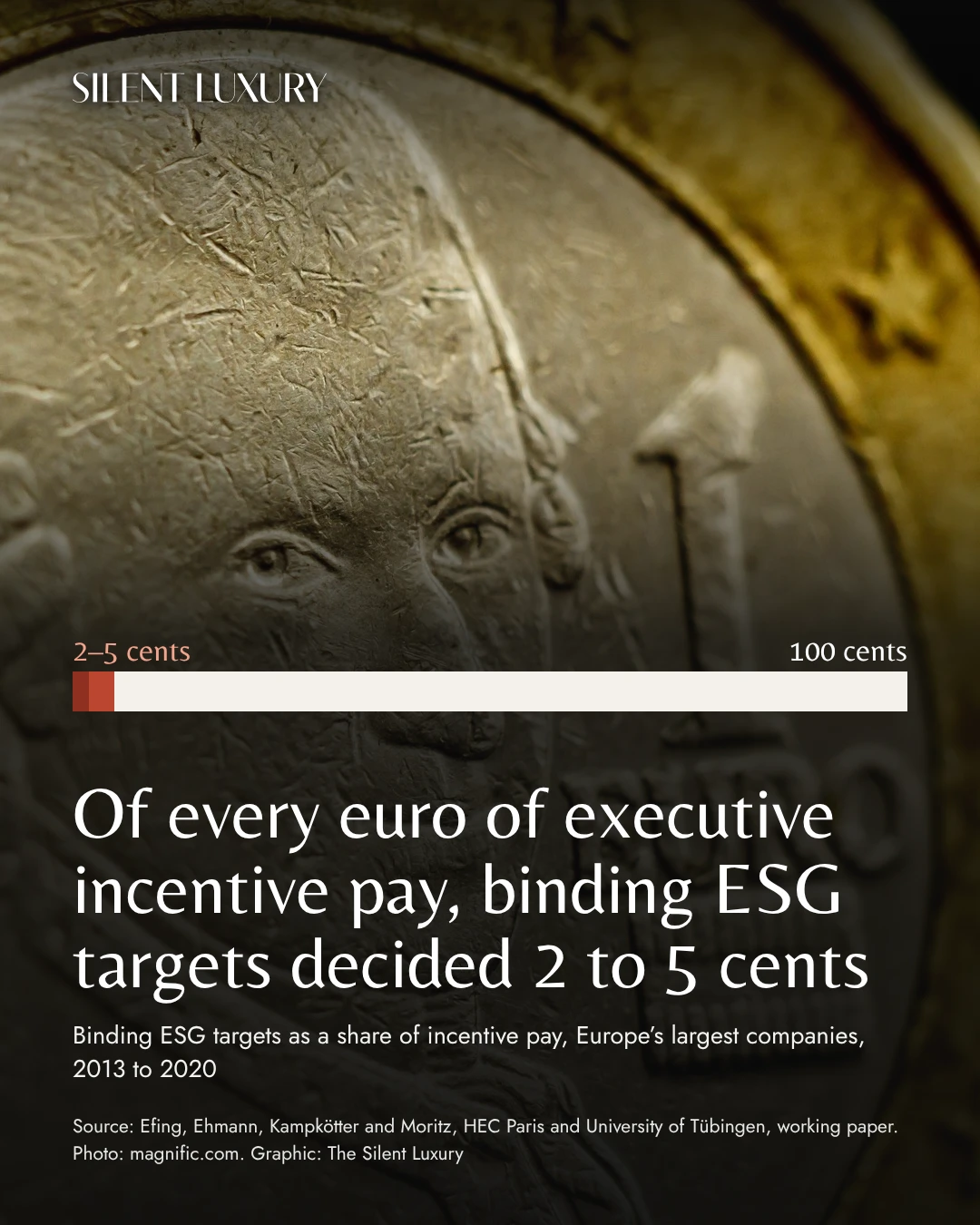
The fairest case for the retreat is that much of what is leaving was worth little while it lasted. At Europe’s largest companies, binding ESG targets accounted for 2 to 5 percent of incentive pay between 2013 and 2020, according to a working paper by Efing, Ehmann, Kampkötter and Moritz of HEC Paris and the University of Tübingen. The authors followed 674 executives at 73 companies and found ESG criteria in around 60 percent of pay plans, most of them without a binding target. The paper’s title, “All Hat and No Cattle?”, anticipates its finding, and it has yet to pass peer review.
The American filings tell the same story in individual cases. Apple left its modifier unapplied for 2024 because the bonus had already reached its maximum, although Bloomberg reports that the same modifier added almost $750,000 to Tim Cook’s pay in 2023. For its 2023 to 2025 performance share cycle, Coca-Cola reported that “our sustainability measures reflected threshold performance or below”, and the award still paid out above target. Starbucks fixed three modifiers, sustainability among them, at 0.9 on two earlier cycles, a setting that “assumes below threshold performance”. In these filings the climate targets now leaving the bonus are the ones that seldom moved it. By that standard, a board that pays only for results it can measure is easier to hold to account than one that paid for targets with so little effect on the money.
Net Present Virtue: What Survives Has to Pay Back
What survives in the bonus is the part of sustainability that earns its keep on the company’s own books, and the hotel groups state this most openly. “Almost all of our hotels are owned by third parties,” IHG says, and its long-term plans give 5 percent to the adoption of energy conservation measures in new and converted hotels, a metric the company describes as “supporting owners” to “reduce energy costs”. The owners make the investment, the saving lands on their energy bill, and the executives are paid for the adoption. Energy per IHG room has fallen 10.2 percent since 2019, while the group’s total emissions rose 7.7 percent over the same years as the hotel system grew, and IHG describes itself as “off track” for its 2030 target, which is under review.
Where the language is that of returns, the transformation leaves. At Valero, low-carbon projects were held to “the same minimum after-tax internal rate of return requirement as our refining projects”, and by the end of 2025 the refiner had invested $6.0 billion in them. When it let the modifier tied to them expire, the compensation committee gave two reasons: the company had met its greenhouse gas target for 2025 early, and there were “adverse conditions and uncertainties” around the expected returns on many of its low-carbon fuel investments. At Shell the weight of the energy transition condition in the long-term plan fell from 25 to 20 percent. Inside Shell’s annual bonus, the number of electric vehicle charge points gave way to “electric vehicle gross margin growth”, a change the company explains with “the shift in focus to value over volume”.
| Company | What left the incentive plan | What replaced it or stayed |
|---|---|---|
| Verizon | The responsible business metrics in the annual bonus, including its carbon metric | Qualitative strategic and culture goals with the same weighting |
| RTX | The non-financial component of the annual bonus, the Corporate Responsibility Scorecard | 100 percent financial performance, split equally between earnings and free cash flow |
| Ralph Lauren | Citizenship and sustainability metrics in the bonus modifier | A scorecard of AI metrics |
| Valero | The modifier tied to low-carbon projects, left to expire | Relative total shareholder return as the sole long-term measure; the company cited a 2025 greenhouse gas target met early and uncertain returns on low-carbon fuels |
| HSBC | The measure for its own emissions, in the long-term plan for 2026 to 2028 | A 5 percent measure keeping financed emissions in oil and gas and in power within internal risk limits; the committee cited shareholders’ view that the work is “now largely considered business as usual” |
| Rolls-Royce | The Scope 1 and 2 emissions target, 10 percent of the 2025 long-term plan, dropped from the 2026 plan | Free cash flow, operating margin and relative shareholder return, one third each; net zero by 2050 stays as a company goal |
| Shell | Weight of the energy transition condition in the long-term plan cut from 25 to 20 percent; electric vehicle charge points dropped from the annual bonus | Electric vehicle gross margin growth in the annual bonus; growth in normalised free cash flow per share in the long-term plan |
| IHG | Nothing removed | 5 percent of the long-term plans for the adoption of energy conservation measures in new and converted hotels |
Source: company proxy statements, annual reports and remuneration reports, 2025 and 2026.
The rule has exceptions, and they matter because they show that the logic is a choice. In its 2025 filing Verizon defended its carbon metric with a cost argument, and a year later it replaced the metric all the same. HSBC removed the measure for its own emissions from its long-term plan for 2026 to 2028, citing shareholders’ view that the work is “now largely considered business as usual”. Rolls-Royce dropped the emissions target from its long-term plan for 2026 while keeping net zero by 2050 as a company goal. At Valero and HSBC alike, what counts as achieved stops being paid for, and the target stays in the annual report while the money leaves the bonus. The 2026 Net Zero Stocktake still finds net zero targets at 64 percent of 1,957 large listed companies worldwide, and at 51 percent in the United States.
The sentence that closes the decade came from Marriott. In its 2026 proxy statement, the board committee that used to oversee “science-based emissions reduction targets” now oversees “sustainability and operational resiliency strategies”. On 12 February 2026 the company wrote that it evaluates sustainability initiatives “consistent with the approach we apply to other corporate initiatives”, with larger investments going through an analysis that “may include” a cost-benefit review, “net present value (NPV), internal rate of return (IRR)”. Sustainability entered the decade as a promise to investors. At Marriott in 2026 it is a line in the capital budget, competing for money on the same terms as everything else, and that is net present virtue in its plainest form.
Europe’s Other Route: ESG Executive Pay, Shorter Reports and Product Law
Europe’s boards have kept climate in executive pay, while Europe’s lawmakers have cut the sustainability report and tightened the rules for products. Among the 300 largest European companies, WTW counts at least one ESG metric in the incentive plans of 94 percent, against 76 percent in the S&P 500, and carbon reduction is the most common measure, at 70 percent. In France the Afep-Medef code has asked since December 2022 for at least one criterion tied to the company’s climate objectives. The filings show what holding looks like. In its annual bonus Heidelberg Materials applies a CO2 multiplier between 0.7 and 1.3 to net income, and Hermès ties 10 percent of the variable pay of its executive chairmen to CSR criteria. For 2025 Accor set Sébastien Bazin a 4 percent cut in water intensity. The group achieved 5.2 percent, and the criterion paid out at 136 percent. Under its new chief executive Luca de Meo, Kering takes climate out of the 2026 annual bonus and keeps a 10 percent climate target in the long-term plan, an absolute cut of 12 percent across Scope 1 to 3 by 2028.
The retreat in Europe runs through disclosure. The Omnibus I Directive, in force since 18 March 2026, limits sustainability reporting to companies with more than 1,000 employees and €450 million in turnover, which the PRI estimates removes around 90 percent of companies from the original scope. It also deletes the duty to adopt a climate transition plan from the due diligence directive. In the same year the rules for products tightened. Since 19 July 2026, large companies have been barred from destroying unsold clothing and footwear, and since 27 September the Empowering Consumers for the Green Transition Directive has banned generic environmental claims without proof and climate-neutral claims based on offsetting. Producer responsibility schemes for textiles must follow by April 2028. Leather took the opposite direction: a delegated act of July 2026 removed hides, skins and leather from the deforestation regulation, although the Commission’s own estimates put leather at up to 17 percent of the deforestation risk in EU imports, a figure the industry disputes. Inside this narrower frame, luxury has written supply-chain rules of its own, 46 shared requirements from FHCM and CNMI.
The Pattern: ESG Executive Pay in Thirty-Three Companies
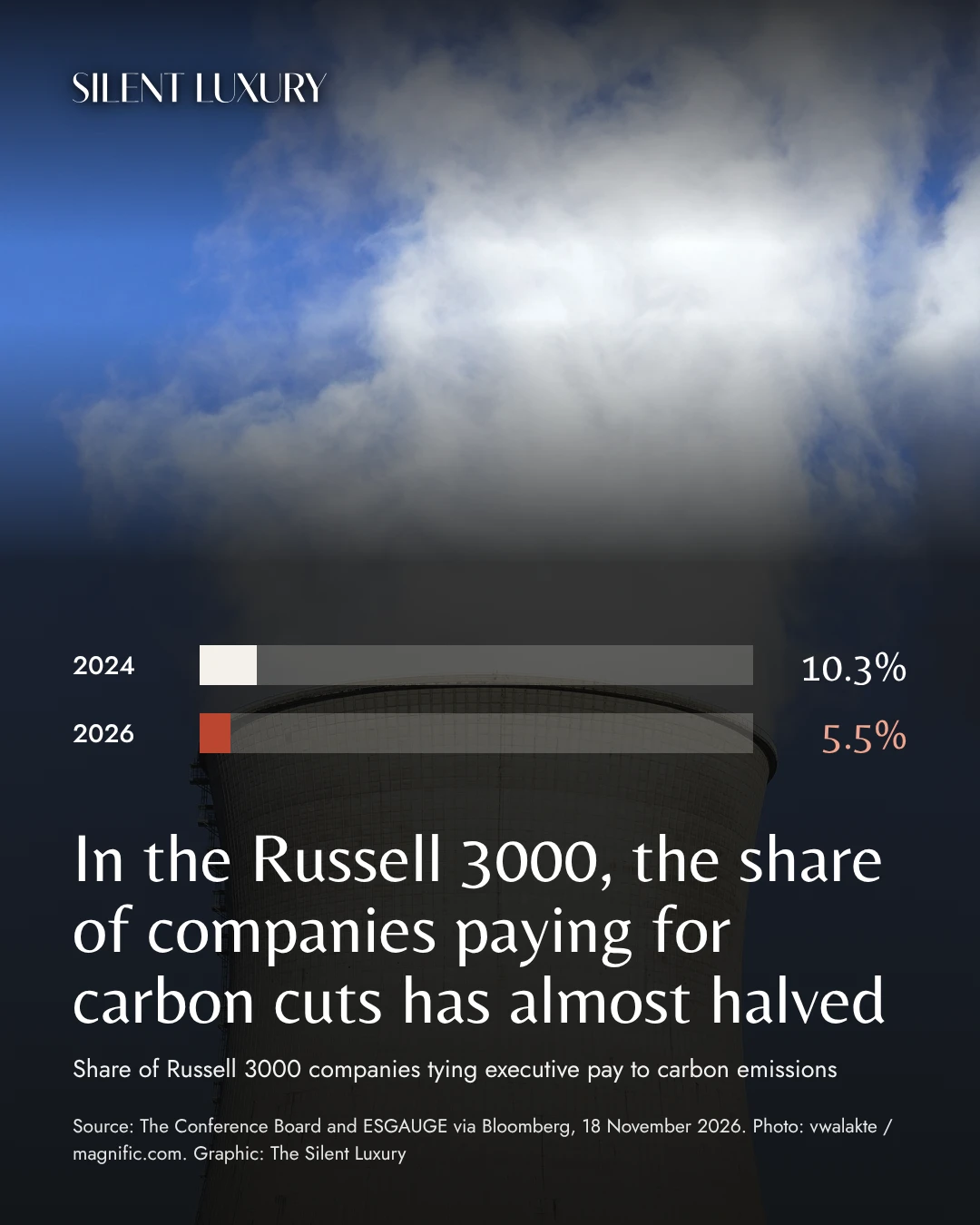
The net zero target tracker follows 33 companies through their filings, and the decline it records in the United States runs across sectors and across types of metric. In the short-term plans of 400 S&P 1500 companies, WTW finds ESG measures at 55 percent, four points fewer than two cycles earlier. In the Russell 3000 the share of companies tying pay to carbon emissions fell from 10.3 percent in 2024 to 5.5 percent in 2026, according to the Conference Board. Griffon “removed ESG as a performance metric” after what it calls “prior shareholder input”, and Salesforce removed its ESG metrics “in response to the evolving regulatory environment” and now ties its performance options to recurring revenue from Agentforce, its AI agents. British companies trim and shift. At bp, the emissions measure left the annual bonus while the weight of emissions in the long-term plan rose from 15 to 20 percent, and Burberry moved its net zero target from the 2039/40 financial year to 2049/50. On the continent most plans hold, with two ESG categories worth 12 percent of the executive board scorecard at UBS and a 30 percent sustainability block in the Airbus long-term plan that includes the emissions its aircraft produce in service.
The Open Question: Who Holds the Long Clock Now
A return test can make the system more honest, because only what works still counts, and some of what remains does work: energy per room at IHG has fallen, and Accor cut its water intensity by more than it promised. The same test also decides which part of the transition waits. Projects with long paybacks and uncertain returns struggle under a test of net present value, Valero’s low-carbon fuels lost their place in the plan when their returns weakened, and Shell’s annual bonus now counts margin in electric vehicles where it once counted charge points. Net present virtue keeps the efficiency and leaves the transformation to whoever is still willing to hold the long clock, and the open question is who that will be, and at what price.
Delta Air Lines has a small answer of its own. The airline says it remains committed to replacing 10 percent of its jet fuel with sustainable aviation fuel by 2030, and it now calls net zero by 2050 an “aspiration”. Its management bonus pays on pre-tax income and on operational goals such as on-time performance and baggage handling.
Send this to someone who votes on executive pay in the next proxy season.
Continue Reading
-
The Luxury Economy at a Turning Point: What 2026 Revealed
The luxury industry ended 2026 at about the same size, with its growth gathered among clients who already buy and in goods that hold their value. In the third quarter, LVMH grew by 1 percent on an organic basis, Hermès by 4 percent and Kering slipped by 1 percent. Ownership of the chain, from the mine and the workshop to resale, is the question that will shape 2027.
-
The Return on Repair: What Circular Fashion Pays Back to LVMH, Gucci and Patagonia
Circular fashion describes the market around repair, resale, take-back, refill, authentication and product care. In 2026 repair alone is worth 500 million euros in luxury, and LVMH, Gucci and Patagonia built the infrastructure earliest. The piece tests whether mending creates lasting value or only moves it from one balance sheet to another.
-
Owning Beats Working: AI Wealth and the American Dream on Credit
In 2026 the American economy runs on two engines: corporate investment in artificial intelligence and the spending of its wealthiest households. The four largest hyperscalers plan roughly 725 billion dollars in capital expenditure this year, while the US median household income stands at 83,730 dollars, unchanged in real terms.
Sources
Company filings (SEC, DEF 14A): Verizon 2026, Verizon 2025; Valero 2026, Valero 2025; Apple 2026, Apple 2025; RTX 2026, RTX 2025; Microsoft 2026; Oracle 2026; Delta 2026; Parker-Hannifin 2026; Coca-Cola 2026; Griffon 2026; Salesforce 2025, Salesforce 2026; Starbucks 2026; Ralph Lauren 2026; Hilton 2026, Hilton 2025; Marriott 2026, Marriott 2025.
Annual reports, remuneration reports and statements: Marriott, Supplemental Statement on Sustainability Initiatives (12 February 2026); IHG, Directors’ Remuneration Report 2025; IHG, Strategic Report 2025; Shell, Form 20-F 2025; bp, Annual Report and Form 20-F 2025; HSBC, Annual Report on Form 20-F 2025; HSBC, Annual Report on Form 20-F 2024; Rolls-Royce, 2025 Annual Report; Burberry, Annual Report 2025/26; Eni, Remuneration Report 2026; UBS, Annual Report 2025; Airbus, 2025 Remuneration Policy; Airbus, AGM 2026 Information Notice; Accor, Board decisions (19 March 2026); Accor, Board decisions (18 February 2026); Kering, 2025 Universal Registration Document; Heidelberg Materials, Remuneration Report 2025; Hermès, release on compensation (16 February 2026); BlackRock, Larry Fink’s 2020 Letter to CEOs.
Regulators and EU law: The White House, Unleashing American Energy (20 January 2025); SEC, C&DI 103.12 (11 February 2025); SEC, Staff Legal Bulletin No. 14M (12 February 2025); SEC Press Release 2025-58 (27 March 2025); Directive (EU) 2026/470 (Omnibus I); Directive (EU) 2024/825 (ECGT); Regulation (EU) 2024/1781 (ESPR); Directive (EU) 2025/1892 (Waste Framework, textiles); European Commission, destruction of unsold clothes and shoes (9 February 2026); European Commission, Digital Product Passport for textiles; European Commission, EUDR and leather (13 July 2026); Afep-Medef Corporate Governance Code, December 2022, section 26.1.1 (ECGI); Lefebvre Dalloz on the Afep-Medef code.
Alliances: Net Zero Asset Managers, news; Net Zero Asset Managers, relaunch (25 February 2026); UNEP FI, launch of the Net-Zero Banking Alliance (21 April 2021); PRI on the final Omnibus agreement (16 December 2025).
Studies and analyses: HEC Paris Knowledge and University of Tübingen (idw) on Efing, Ehmann, Kampkötter and Moritz, “All Hat and No Cattle? ESG Incentives in Executive Compensation”, working paper; WTW, Europe (22 January 2026); WTW, United States (22 January 2026); WTW, Executive pay trends in 2026 (8 May 2026); Proxy Pro, ESG pay metrics; Trellis on the Net Zero Stocktake 2026; Net Zero Compare; Sustainability Online on Harvard Law School Forum on Corporate Governance (27 April 2026).
Law firms: Cooley on SEC staff guidance (14 February 2025); Linklaters on Omnibus I; Latham & Watkins on Omnibus I.
Press: Bloomberg via Accounting Today (18 November 2026); NPR (14 January 2020); Reuters via Insurance Journal (14 January 2025); Reuters via Insurance Journal (3 October 2025); ESG Today (14 January 2025); ESG Today on the Green Claims withdrawal (4 November 2026); ESG Dive on the NZAM relaunch; ESG Dive on the NZBA; Banking Dive on the NZBA; Mongabay (July 2026); Mongabay (September 2026); World Footwear; Health Policy Watch on COP30; UNFCCC, Simon Stiell at the COP31 closing plenary (22 November 2026); Daily Sabah on the end of COP31 (22 November 2026); NPR on COP31 (22 November 2026); CNC3 on the AOSIS closing statement (22 November 2026).
© The Silent Luxury
© The Silent Luxury. You are welcome to quote from this article and to share it, with credit to The Silent Luxury and a link to this page. We are glad to see it travel. Republishing the full text needs our permission, and images remain with their credited owners. Questions are always welcome: eva.winterer@silent-communications.com
Similar Articles

Net Zero Asset Managers: BlackRock and Vanguard Quit, and the Alliance Dropped 2050

ESG Meaning: 36 Terms That Explain the Climate Retreat in Plain English

The ESG Backlash: Big Companies Are Dropping Carbon Targets From CEO Pay