Titan Q2 2026: Grown at Home, Bought Abroad

When Ajoy Chawla presented Titan’s first-quarter figures to analysts in August, he spent part of the call talking them down. Chawla, who had run the Tata Group company’s jewellery business since 2019 and became its managing director in January, had a 41 per cent rise in consumer revenue to explain, and he asked the analysts to keep it in proportion. Over a quarter or two, he said, it might look as if Titan had hit the ball out of the park. “It is not just us. The market also has done very well.”
He meant it as modesty. It also describes what has changed in India. The market he spoke of is buying more jewellery, more watches and more spectacles, and it is buying them increasingly from an Indian group that designs and makes its own. On 6 October, Titan reported that its businesses in India grew 22 per cent in the three months to September, with watches up 30 per cent and eyewear up 28 per cent, both ahead of jewellery. Outside India the figure was 97 per cent, and most of that came from a jeweller in Dubai that Titan bought at the start of the year.

For the European houses, India has so far been a destination. Swiss watch exports to the country rose by more than 31 per cent in the first half of 2026, and the falling import duty on Swiss watches is drawing purchases away from Dubai and Singapore and into official boutiques in Mumbai and Delhi. Titan’s quarter shows the other side of the same market. The country the industry has come to treat as a new geography of demand is also building houses of its own.
Titan at home and abroad
Growth in the three months to September 2026, compared with a year earlier. In India, Titan bought nothing. Abroad, the figure includes Damas, the Dubai jeweller it has consolidated since January 2026.
22%
India, without acquisitions. Watches 30%, eyewear 28%, jewellery 21%.
97%
Abroad, including Damas. Titan has not published a figure without it.
Stores abroad
- Titan’s own stores: 32, then 35
- 127 stores that came with Damas
Source: Titan Company, Q2 FY27 business update (6 October 2026), Q2 FY26 and Q4 FY26 business updates. Titan reports growth as published, including acquisitions. Own stores in March 2026 (35) are a TSL calculation: 162 minus 127.
Titan in India: Growth Without Acquisitions
Titan began in 1984 as a joint venture between the Tata Group and the industrial development corporation of Tamil Nadu, and its watch factory in Hosur opened three years later. Tanishq followed in 1996, eyewear in 2007, and in 2016 Titan took a majority stake in CaratLane, an online jeweller. Each of these businesses began in India, and in the financial year to March 2026 the group’s revenue passed 750 billion rupees.

The figures for India still contain no acquisition, because Titan reports its business at home separately from its business abroad. In the second quarter, its Indian businesses grew 22 per cent, after 37 per cent in the three months before. Jewellery, still the largest of them, grew about 21 per cent, and within it studded pieces outpaced gold, growing by a percentage in the early thirties against about 20 per cent for plain gold. “We began seeing a resurgence of studded in the fourth quarter of last year,” Chawla told analysts in August. Watches grew 30 per cent, which Titan attributed to customers choosing more expensive pieces, eyewear 28 per cent and CaratLane 32 per cent. The company opened 78 stores in the quarter and now has 3,758.
Management explains the room for growth with forces that reach well beyond a single quarter: the formalisation of the Indian market, as buyers move from unbranded sellers to established names, the rise of middle India as a buying public, and customers who trade up once they have bought a first piece. It is the same buyer the European houses describe from the other end. In the United States, the aspirational customer has stepped away from the traditional marques, leaving the middle of the market thinner each quarter. In India, that customer is arriving, and much of what the customer buys first is made in India.
A note from The Silent Luxury
Good reading deserves to find you again.
Titan Vetra: From Edge to a Movement Made in Hosur
Watches show the development most clearly. In 2002, Titan launched Edge, which it presented as the slimmest watch in the world, a quartz record that put an Indian name on a question of precision. Two decades later, its move into higher price segments read as a sign that India intended to make luxury as well as buy it, and a group of independent makers, from Jaipur to Bangalore, began building mechanical watches for a younger Indian collector.
Vetra is Titan’s answer at scale. The company’s own automatic movement is designed, assembled and tested in Hosur, in the factory where its first watches were made, and has more than 130 components. The first collection built on it, Titan Automatics, runs for up to 72 hours on a full wind. Kuruvilla Markose, who runs the watch division, described the ambition in an interview in September as “making India a third force to reckon with in horology”, and Rahul Shukla, the division’s chief sales and marketing officer, called Vetra a statement of what Indian watchmaking can create.
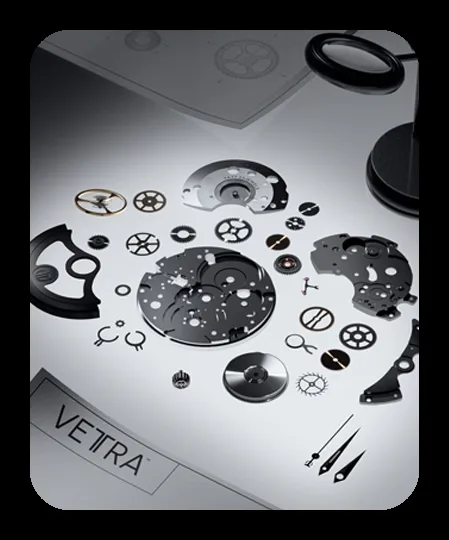
Mechanical watches remain a small part of a business that makes around 20 million watches a year. Titan expects them to bring in about 3.5 billion rupees this financial year, up from about 2.75 billion the year before. A hand-wound movement 2.2 millimetres thick is planned for early 2027, and Markose has said that Titan may one day supply Vetra movements to India’s independent watchmakers, which would make Hosur a supplier to the very makers who have been building the country’s reputation in mechanical watches.
Titan Abroad: Damas in the Gulf, Tanishq in the United States
Titan has looked abroad for a long time. It launched its watches in Europe in 1993, and Tanishq entered the United States in 2023. What changed this year is the scale, and the way it was reached. At the start of 2026, Titan completed the purchase of 67 per cent of Damas, a Dubai jeweller founded in 1907, from the Qatari group Mannai Corporation, in a deal that valued the company at 1.04 billion dirhams, about $283 million. It brought Titan 146 stores across the Gulf, an option on the remaining third after 2029, and a name in the region 77 years older than its own.
The acquisition accounts for most of the growth abroad. Titan’s international network grew from 32 stores in September 2025 to 162 in March 2026, and 127 of them came with Damas. Titan attributed the 128 per cent rise in its international business in the first quarter to the consolidation, and the 97 per cent it reported for the second compares a business that now includes Damas with one that did not a year earlier. How much Titan’s existing business abroad grew without Damas, the company has not said. The same caution applies to the Gulf. The last figure for Titan’s own stores there covers January to March 2026, when Tanishq grew about 37 per cent in the region. For the latest quarter, Titan reported only that its Gulf business had held up well in a volatile geopolitical environment and that Damas was showing early signs of recovery, an assessment that includes the acquisition.
North America, by contrast, Titan has built itself, store by store. It described growth there in the second quarter as “strong double-digit” without giving a figure; the last published number, for January to March 2026, was about 50 per cent, after Tanishq had more than doubled its American business the year before. On 29 September, Tanishq opened its eleventh store in the United States, on Pioneer Boulevard in Artesia, in Southern California. Amrit Pal Singh, who runs the business in North America, called it “an important milestone for Tanishq”. He had described the customer in 2025: the Indian diaspora first, and after it a generation born in the United States that is “as much American as they are Indian”. Titan follows its customers abroad, and in America it is following families who first bought from it at home.
LVMH Q3 2026: The Reporting Season Begins
LVMH reports its third-quarter revenue on 12 October, and the other European groups follow over the coming weeks. When LVMH presented its first half on 27 July, its chief financial officer, Cécile Cabanis, described where the group looks for growth: “Wherever there is wealth creation, which we have seen in the US, which we have seen in Korea, there is a strong appetite for luxury.” The sentence ran through LVMH H1 2026: Growing Where Wealth Is Created, and it holds for India too, with a difference the European houses will notice: part of the wealth created there is now spent with an Indian house. Their figures and Titan’s will arrive in the same weeks, measured on different bases, the European groups organically or at constant exchange rates, Titan as published.
Titan is the largest of India’s answers, and not the only one. The independent houses, from Sabyasachi to Forest Essentials, have grown on what Local Soul: The Quiet Rise of Independent Luxury called genuine cultural provenance. Titan has set its own horizon. At its investor day in June, it announced the goal of doubling consolidated revenue and operating profit by the 2029-30 financial year, against 2025-26, and in August Chawla told analysts the company was on course and hoped to do better.
In Hosur, where the first Titan watches were made in 1987, the next movement is 2.2 millimetres thick and due early next year.
New Geographies is a series on The Silent Luxury following how luxury is made, sold and owned across a multipolar world.
Send this to someone who will be watching the luxury results this autumn.
 Continue · The reading
India: The New Geography of Power on the Wrist
India is no longer only a destination for international watch brands. The new collectors, and the Indian makers building for them.
Read the article →
Continue · The reading
India: The New Geography of Power on the Wrist
India is no longer only a destination for international watch brands. The new collectors, and the Indian makers building for them.
Read the article →
Sources: Titan Company, Q2 FY27 business update (6 October 2026), domestic segment figures as reported; Titan Company, Q1 FY27 results and analyst call (August 2026); Titan Company, Investor Day (June 2026); Titan Company, Vetra in-house automatic movement (titan.co.in); Titan Company, announcements on the acquisition of a 67 per cent stake in Damas (21 July 2025) and its completion (2026); Kuruvilla Markose, interview of September 2026; Tanishq, opening of the Artesia store (29 September 2026); Titan Company, Q4 FY26 business update (7 April 2026); Titan Company, FY 2024-25 results; LVMH, first-half 2026 results presentation (27 July 2026); LVMH financial calendar.
Similar Articles
LVMH Q3 2026: The Core Slips in China, the Edges Carry the House
Shein Shares Hit a Record Low as LVMH Falls to a 52-Week Low
Rolex Is Closing the Loop