The Kering owl in flight: A calculated, industrial trajectory defining the ReconKering turnaround. A silent, calculated trajectory meeting a shifting luxury landscape. | Photo: magnific.com
The Renaulution of Luxury: How Platforms Meet the Ateliers
Luca de Meo brings the platform logic of the car industry to Kering, sharing infrastructure across Gucci, Saint Laurent and Alexander McQueen while each house keeps its own hand, and that method marks the shift from brand hype toward durable luxury value.
Eva Winterer
This chapter sets out the logic of our ReconKering Dossier, the method behind how Kering marks the turn in luxury.
Luca de Meo has led the French luxury group Kering since September 2025, the first chief executive from outside the Pinault family. The former Renault boss arranges the houses from Gucci to Alexander McQueen by a method he refined across three decades in the automotive industry: a portfolio of brands governed by shared platforms, defined roles and firm margins. The Silent Luxury reads the ReconKering strategy as a shift in luxury from brand-driven to material-anchored value.
In 2007 an Italian manager unveiled a small car that brought an entire marque back to life. The new Fiat 500 sold in its millions and became a case study in how to turn a tired industrial product into an object of desire. The man behind it was Luca de Meo. Nearly two decades later, he stands at the head of Kering, applying the same question to Gucci, Bottega Veneta and Alexander McQueen: how do you recover desirability once it has been lost.
De Meo has run the group since September 2025, the first chief executive in the company’s history to come from outside the Pinault family. He brings with him a way of thinking that is foreign to the luxury industry. In the car business, no one runs a single car; one runs a range. Brands share platforms so that costs fall and margins rise. Each model is given a role in the portfolio. Loss-makers are restructured or retired. De Meo lays precisely this logic over Kering, and it explains every move of the strategy he presented in April 2026 under the name ReconKering.
The method behind the man
Born in Milan in 1967, de Meo began his career at Renault in 1992 and passed through more than ten brands across twelve countries in three decades. The pattern repeats everywhere. At Fiat he revived the 500 and took on the restructuring of an ailing Alfa Romeo. At SEAT he shaped the loss-making marque into the premium sub-brand Cupra, which sold close to 220,000 units in 2024. At Renault, facing a loss of nearly eight billion euros in 2020, he reached an operating margin of 7.6 per cent and an operating profit of 4.3 billion euros by 2024.
His recurring task was always the same: reposition an ailing brand, order the portfolio, lower costs through shared platforms, recover desirability through product and marketing. When he announced his move to Kering in June 2025, Renault’s share price fell by eight per cent while Kering’s rose by more than thirteen. The market understood at once which method was changing industries.
At Kering that method meets a subject that resists it. A couture house is not a model, an atelier’s work is not a platform component, a cut is not a unit count. The tension between industrial logic and the material of luxury runs through the entire strategy. It shows at every lever, and most sharply where people sit at tables and work with their hands.
ReconKering sets that method into three phases, each with its own horizon.
Kering’s ReconKering strategy in three phases, 2026 to 2030
ReconKering does not arise from a position of strength. The share price over the past year tells the crisis in three movements. In the summer of 2025 the stock sat at its low, around 172 euros on 13 June, the day de Meo’s move became known. From there a strong recovery set in, carried by hope in the new chief executive, almost a hundred per cent in six months. In 2026 the stock gave back ground from that recovered level. On 27 May, the day before the annual meeting, it closed at 250.15 euros, still well below its 2021 peak.
Behind the price sit the figures that make the overhaul necessary. The recurring operating margin, which topped 30 per cent at its 2019 record, fell to 11.1 per cent in 2025 from 14.5 per cent in 2024. Group revenue declined by 13 per cent to 14.67 billion euros in 2025, and recurring operating income dropped by a third to 1.63 billion. Net income attributable to the group held at 72 million euros, against just over a billion the year before, while net income from continuing operations including non-recurring restructuring items turned negative at minus 29 million. Gucci, the flagship that still accounts for around 59 per cent of group operating profit, fell to 5.99 billion euros, down 22 per cent. By the first quarter of 2026 revenue stood at 3.57 billion euros, down 6.2 per cent as reported and broadly stable on a comparable basis, with Gucci off a further 14 per cent. On the day of the strategy presentation in Florence the stock lost 4.3 per cent. The Bernstein analyst Luca Solca caught the mood plainly: it is easier and faster for the market to believe in a revival than it is for management to engineer one.
The overhaul meets a market that is shifting on its own, and for a carmaker that shift is familiar. The global market for personal luxury goods stalled in 2025. The base of active luxury customers shrank from around 400 million in 2022 to between 330 and 340 million in early 2026, driven by the retreat of the aspirational shopper, the middle-class buyer who carried two decades of growth. Affluent buyers keep spending; their share of luxury outlays in the United States rose from 30 per cent in 2019 to 47 per cent in 2026.
This divergence moves weight away from soft luxury, whose value rests on season and brand management, towards hard luxury, whose value rests in material, durability and resale. Jewellery, high jewellery and watches are growing while leather goods and fashion give way. The True-Luxury study by BCG and Altagamma names the cause with unusual sharpness: in the race for scale, the industry lost its soul and traded exclusivity for reach. This is precisely the market dynamic de Meo knows from the car industry, where the premium marques grew while the middle came under pressure. His answer at Kering follows the same reflex: move up, into the material, into the lasting.
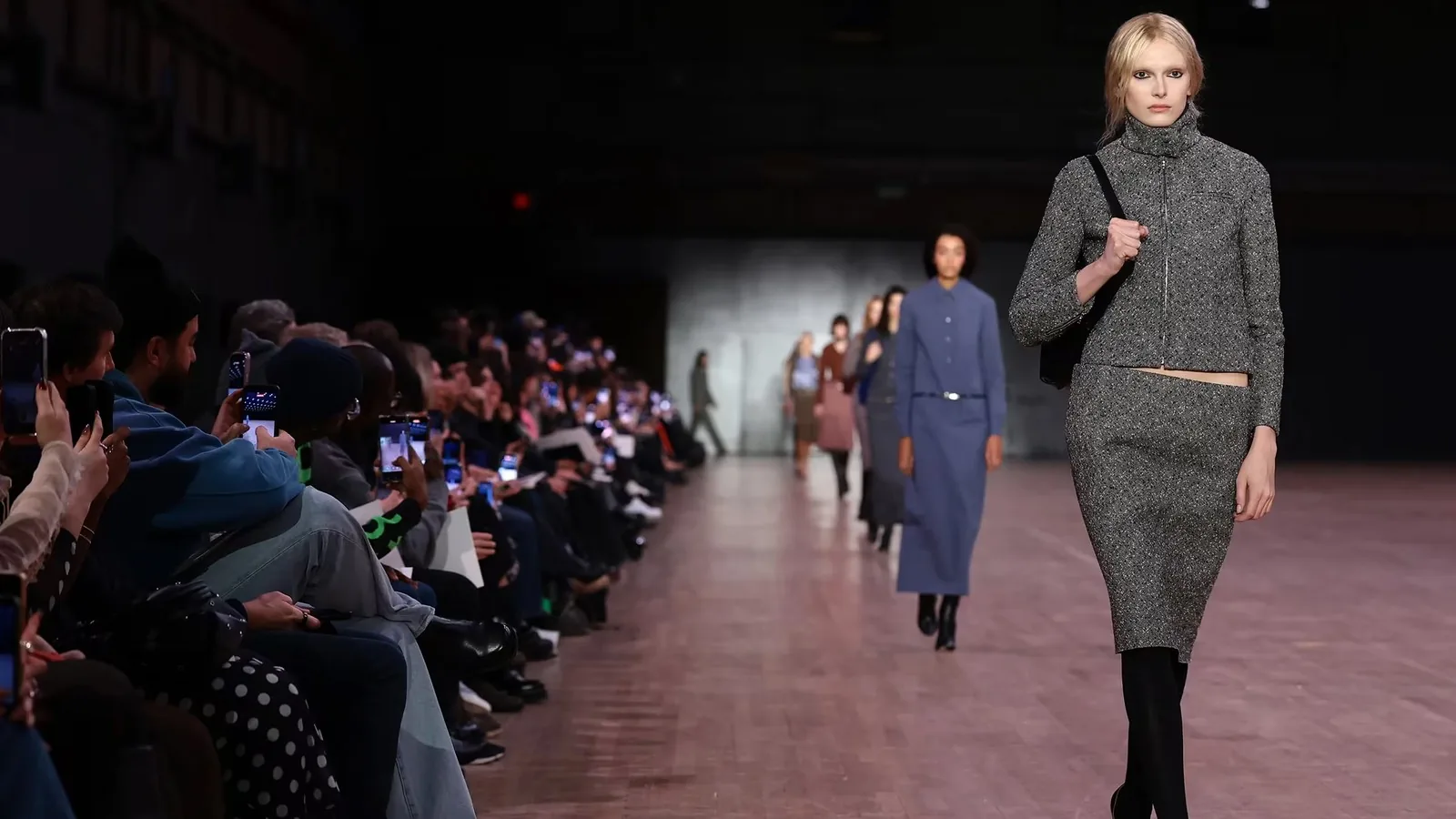
McQueen is the case in which the method first becomes visible. The house is being returned to its British tailoring identity, with women’s ready-to-wear, tailoring and eveningwear at its core. In group language the model is “leaner and more disciplined”: tighter collections, a reduced store network, a streamlined organisation. The losses are real enough to show in the group accounts: Kering’s own 2025 report names the UK losses generated by Alexander McQueen as a reason its effective tax rate rose to 36.1 per cent. Industry estimates put the house at around five per cent of group revenue, with turnover down by roughly 60 per cent across the recent crisis years, driven by overexpansion to as many as 135 stores and a dependence on sneakers that at times made up the bulk of turnover. A house founded on radical work on the body was, for a critical period, a sneaker business with a runway attached.
At the annual meeting on 28 May, de Meo sharpened his tone. A luxury house must make money, he said, otherwise he ejects it from the system. He named four houses: McQueen, Brioni, Ginori 1735 and Pomellato, each on a two-year clock running to April 2028. Three days later, on 1 June and after market close, he appointed Gianfranco D’Attis as CEO of McQueen. D’Attis embodies the method in person, a turnaround manager with retail discipline, most recently brand CEO of Prada, before that Christian Dior Couture Americas and Jaeger-LeCoultre. Kering’s release describes his Prada years as a strengthening of desirability. The record is more measured. D’Attis left Prada at the end of June 2025 after a little over two years by mutual agreement, attributed by observers to differences over strategy, at a point when Miu Miu rather than the Prada brand was the true engine of growth. Kering is therefore bringing in an experienced retail manager whose last posting was no clear success. For a turnaround case, that is a plausible choice.
While Florence celebrated the Accademia per le Eccellenze, with up to two thousand training places a year in prospect, McQueen was negotiating over jobs in Italy. The collective dismissal procedure opened on 12 March covered 54 of 181 employees in Scandicci, Novara and Parabiago, around a third of the Italian workforce. On 20 May, more than a thousand workers from across the Kering group laid down their tools in Scandicci, from Gucci, Saint Laurent, Bottega Veneta, Balenciaga, Ginori and Brioni. On 4 June a settlement followed at the Ministry of Labour: the unilateral dismissals were withdrawn, the number of redundancies fell from 54 to 35, departures now voluntary only. The unions declared the dispute unfinished.
Here the gap inherent in the whole strategy opens. Kering nowhere connects the craft investment of the Accademia with the cuts in Scandicci. Whether departing employees will be absorbed by the academy or through the new group platform remains unanswered. The factory logic meets the thing it cannot represent. A car has no hands. A couture house does.
The direction: jewellery, China and lasting value
The clearest strategic moves lie beyond fashion and show where de Meo is steering the group. In March 2026 Kering gathered Boucheron, Pomellato, DoDo and Qeelin into its own segment, Kering Jewellery, and secured the industrial base for it through the staged acquisition of Raselli Franco. In the first quarter of 2026 the jewellery segment reached a record and grew at double-digit rates while fashion contracted. It is the building of a material-anchored sub-brand on the Cupra pattern, a value that rests not in the logo but in the gold.
The second move leads to China. Through the vehicle House of Wonders, Kering acquired a minority stake in ICICLE, a house grown in Shanghai since 1997, with more than 200 stores and an aesthetic of natural materials and quiet restraint. On China it is worth parting company with the usual consultancy language, which promises that the market will return to former strength given enough marketing budget. Trust in China is organised through guanxi, through personal networks of relationship that adhere to people and to grown structures, not to a brand and not to a campaign. Visibility can be bought; rootedness cannot. This is precisely where the ICICLE stake works. Kering is not scaling up a China machine of its own; it is acquiring a foothold within an existing network.
How Luca de Meo’s method applies across Kering’s four strategic axes
At this point the corporate strategy touches a larger movement. Kering is moving away from conspicuous brand presence and towards material, origin and restraint. The year’s most rigorous research carries this direction. The True-Luxury study by BCG and Altagamma shows that aspirational-heavy houses fall most steeply and that the top 0.1 per cent of customers account for 37 per cent of market value. Deloitte has 420 executives put on record that value is overtaking volume and that the future of luxury lies in lasting attachment, in relationship-based value creation. Capgemini, in its World Wealth Report, measures the wealth base behind that top segment.
Three independent sources thus describe the same shift: from signal to attachment, from reach to rootedness, from price tag to lasting value. Kering’s motive in all this is commercial, not philosophical. The group seeks resilience and access, not a creed. That is exactly what makes the finding robust. When a carmaker driven by margins reaches for the very values held to be the future of luxury, those values have become a market movement.
Whether the Renaulution of luxury succeeds will be decided first at the tables in Scandicci. A method that places material above the brand will be measured by how it treats the people who know the material. The clock de Meo has set his houses runs to April 2028. The question of the Italian ateliers stays open until September.
Kering, ReconKering strategy and Capital Markets Day, Florence, 16 April 2026. kering.com
Kering, First-quarter 2026 revenue, 14 April 2026, and full-year 2025 results, 10 February 2026. kering.com
Kering, Gianfranco D’Attis appointed CEO of Alexander McQueen, 1 June 2026. kering.com
Kering, launch of Kering Jewellery under Jean-Marc Duplaix (16 March 2026), the ICICLE partnership with ICCF (16 April 2026) and the Accademia per le Eccellenze (15 April 2026). kering.com
WWD, Kering Q1 2026 results, the Capital Markets Day analyst reaction and the 28 May annual meeting. wwd.com
Reuters, the ReconKering memo to senior executives. reuters.com