
Fendi Baguette: A Commission for Emirati Craftswomen
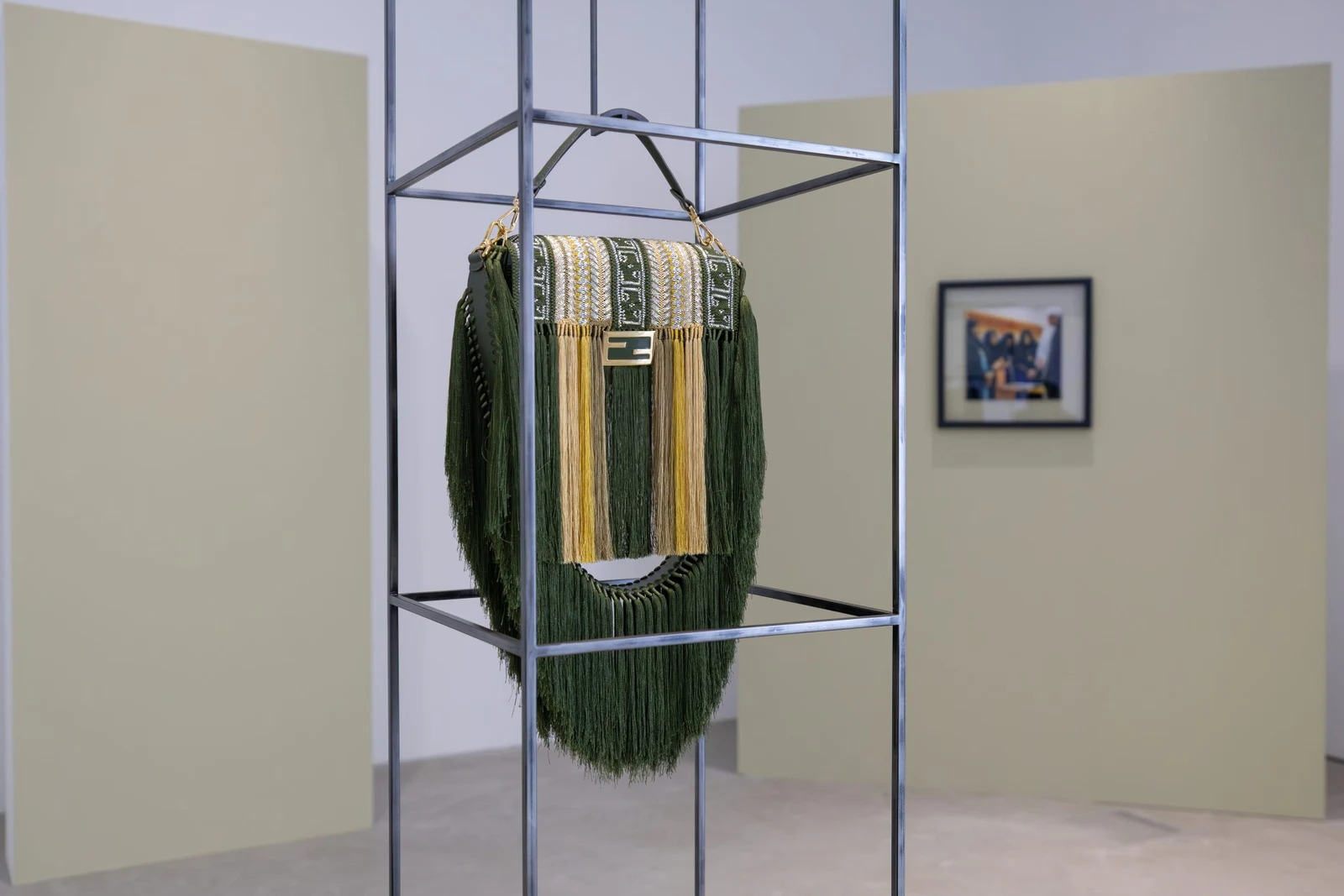
Twelve craftswomen from the Irthi Contemporary Crafts Council in Sharjah spent 435 hours over two years embroidering a limited edition of Fendi’s Baguette in Talli, the interlaced embroidery of the Emirates. The Emirati designer Khalid Shafar was creative director. Sheikha Jawaher bint Mohammed Al Qasimi unveiled the bag at Al Hamriyah Studios in Sharjah on 31 October.
● In brief
The commission. The work went to Irthi’s craftswomen, not to a Fendi workshop in Italy. Talli, a traditional Emirati embroidery, braids threads by hand into narrow patterned bands. Irthi says its programmes have developed more than 80 Talli designs and patterns.
The design. Shafar reinterpreted an Arabic letter, drawing on the geometry of Kufic script and on Fendi’s logo. The palm green, Ghaf-tree grey and mustard come from the Emirati landscape.
The proceeds. Part of the proceeds goes to The Big Heart Foundation, which supports refugees and vulnerable communities. Fendi and Irthi have not published the size of the edition, the price or where the bag will be sold.
The precedent. Fendi, part of LVMH, has used the Baguette as a vehicle for luxury craftsmanship before. Its Hand in Hand project of 2020 asked twenty Italian ateliers, one for each region, to make their own version of the bag. The Emirati edition takes the idea to the Gulf.
● Why it matters
The Middle East is building a supply side for the luxury market, not only a client base. Irthi, set up in Sharjah in 2015, works with more than 500 craftswomen. Its stated aim is an artisan economy for women, reached through new markets that international designers and brands open up. A commission from Fendi is that model at work: an Emirati heritage skill placed inside one of fashion’s best-known products, with Emirati craftsmanship named as the source.
Talli carries a value that Fendi cannot produce in Rome. UNESCO added Al Talli to its list of the intangible cultural heritage of humanity in 2022 and noted that the craft gives its practitioners an income. In the same decision, it warned of the risk of over-commercialisation. A luxury edition sits exactly on that line.
Whether the commission pays off for the craftswomen is still open. Both partners lead with the 435 hours. Neither says what those hours earned the women, or how many bags there are. The test is what follows: further orders, a price that reflects the hours, and the craftswomen named beyond the launch.
Send this to someone who asks who makes luxury goods, not only who buys them.
 Continue · The reading
African Craft Knowledge as Luxury Value, 75,000 Years Deep
Who owns the knowledge inside a technique, and who is paid for it: provenance and authorship as luxury value.
Read on →
Sources
- Sharjah24 (Sharjah Government Media Bureau), Jawaher Al Qasimi unveils Emirati edition of FENDI’s “Baguette”, 31 October 2026: sharjah24.ae
- WAM (Emirates News Agency), Jawaher Al Qasimi unveils Emirati edition of FENDI’s ‘Baguette’, 31 October 2026: wam.ae
- UNESCO, Decision 17.COM 7.B.32, Al Talli, traditional embroidery skills in the United Arab Emirates, 2022: ich.unesco.org
- Crafts Council (UK), Irthi empowers women socially and economically through craft: craftscouncil.org.uk
- LVMH, Fendi celebrates Italy’s artisanal craftsmanship with ambitious “Hand in Hand” project: lvmh.com