Dirty Looks: Desire and Decay in Fashion
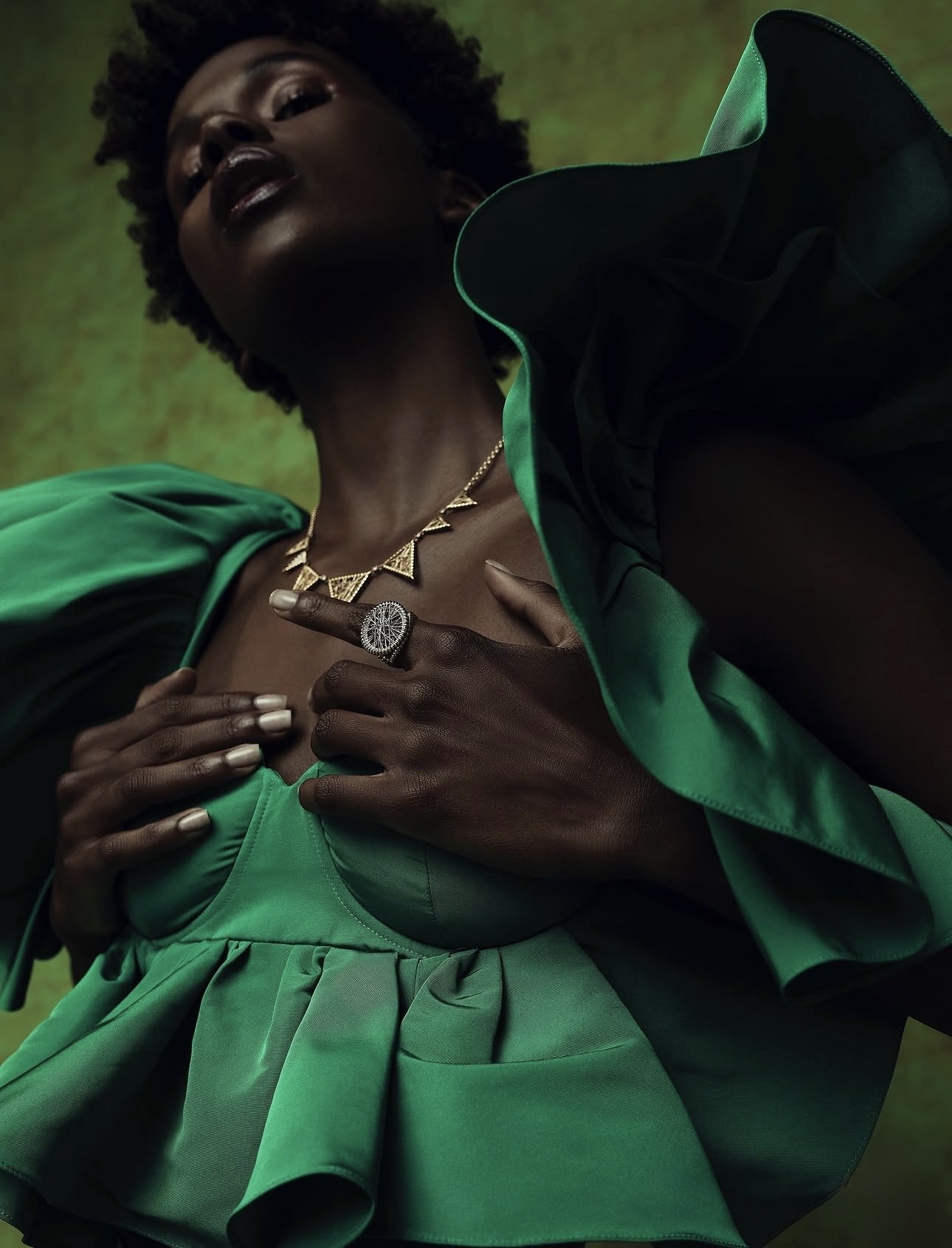
In the heart of the Barbican’s raw concrete, a new kind of beauty is breathing. ‘Dirty Looks: Desire and Decay in Fashion’ invites us to look past the polished surface and feel the pulse of the earth. From the legendary ‘Nostalgia of Mud’ to garments unearthed from the soil, this exhibition is a journey through half a century of material rebellion. It is the living feeling of fashion that refuses to be silent—where a stain becomes an ornament and a tear is a testament to resilience. Here, we rediscover luxury not in perfection, but in the honest, visceral connection between our bodies, our clothes, and the ground beneath us.
Fashion has long defined itself through immaculate silhouettes, refined textures, and unblemished purity. Luxury was synonymous with surfaces that erased any trace of reality.
Yet since the 1980s, a counter-movement has emerged: dirt, decay, and deliberate imperfection have become aesthetic tools. What began as a critique of established beauty ideals has evolved into an exploration of transience, spirituality, and ecological responsibility. These themes gain urgency in an era of climate change and overproduction.
“Dirty Looks: Desire and Decay in Fashion”, the recently opened exhibition at the Barbican Centre (25 September 2025 to 25 January 2026), takes this evolution as its starting point for a comprehensive survey. Curated by Karen Van Godtsenhoven and Jon Astbury, the show presents over one hundred looks from more than 60 designers across Europe, Asia, Africa, and the Americas. The designers range from established figures such as Vivienne Westwood and Hussein Chalayan, to a new generation including Elena Velez, Paolo Carzana, and IAMISIGO. The exhibition juxtaposes the Barbican’s brutalist architecture with motifs of decay, inviting visitors to view “dirt” not as a flaw but as a metaphor for regeneration and resistance. Here, fashion serves as a mirror to human existence: born of the earth, shaped by time, and part of a perpetual cycle.
Let’s take a first short tour through the exhibition.
The Poetics of Transience
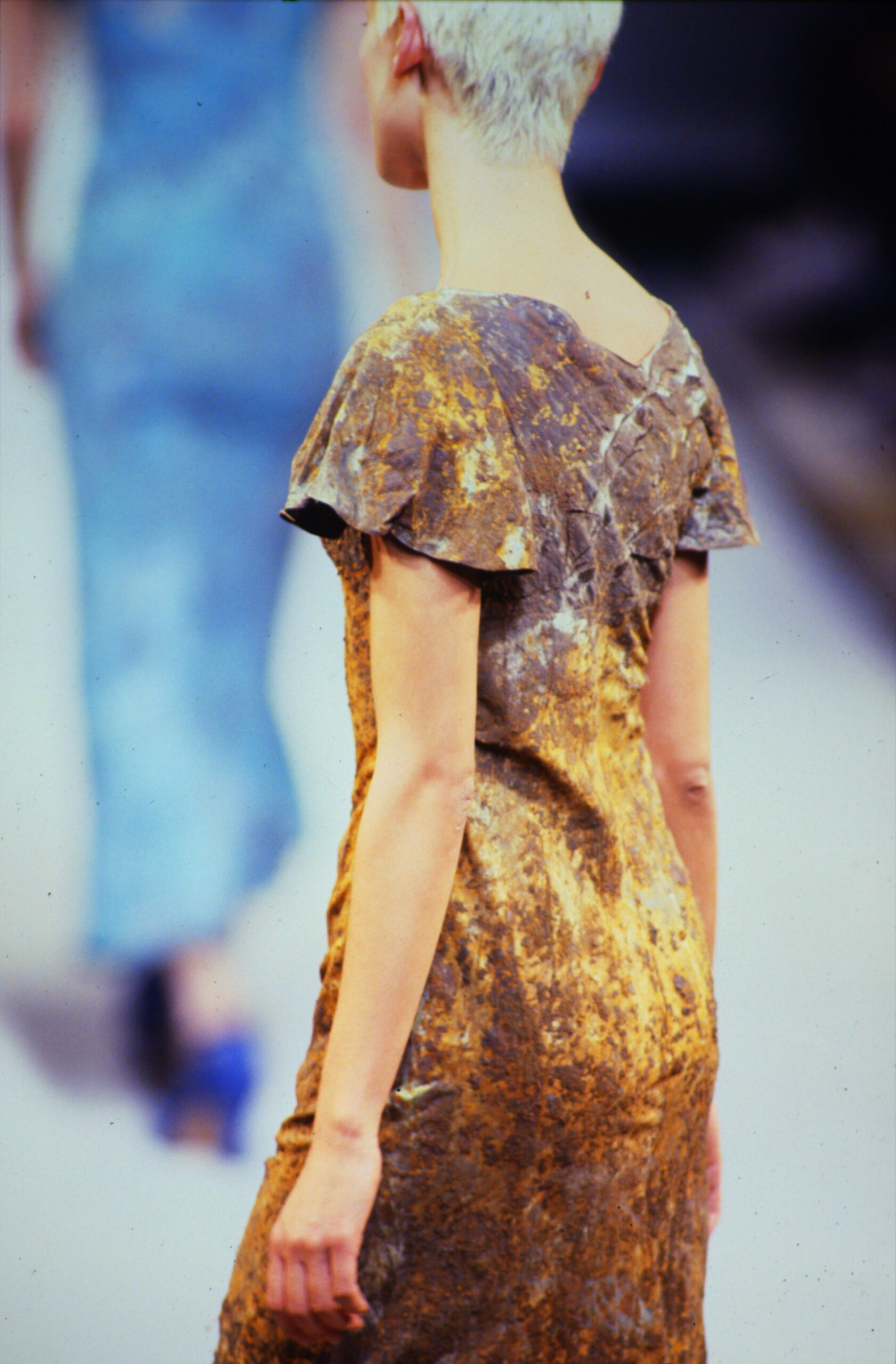
The exhibition opens with Hussein Chalayan’s “Future Archaeology” (1993–2002). The Turkish-Cypriot designer, a Central Saint Martins graduate, developed a method that treats clothing as an organic process. For his degree collection “The Tangent Flows” (1993), Chalayan buried garments with iron filings in a friend’s London garden. Exhumed months later, they bore marks of oxidation and discolouration. This was the result of a simulated transformation through time and matter.
This technique continued in collections such as “Temporary Interference” (Spring/Summer 1995): a dress treated with copper filings and buried near the Thames acquired an intense green hue. In “Map Reading” (Autumn/Winter 2001), chiffon took on a wood-like quality after burial, with corroded sequins evoking time’s passage. The culmination came in “Medea” (Spring/Summer 2002), where Chalayan disrupted linear time, stating: “A wish or curse that propels the garment and its wearer through historical periods, like a fall through the sediments of an archaeological dig”. Presented in an immersive installation, these pieces transcend aesthetics to address life cycles. Chalayan’s buried garments underscore that fashion, like humanity, originates from the earth and returns to it. This is a provocative notion in the fast-fashion era.
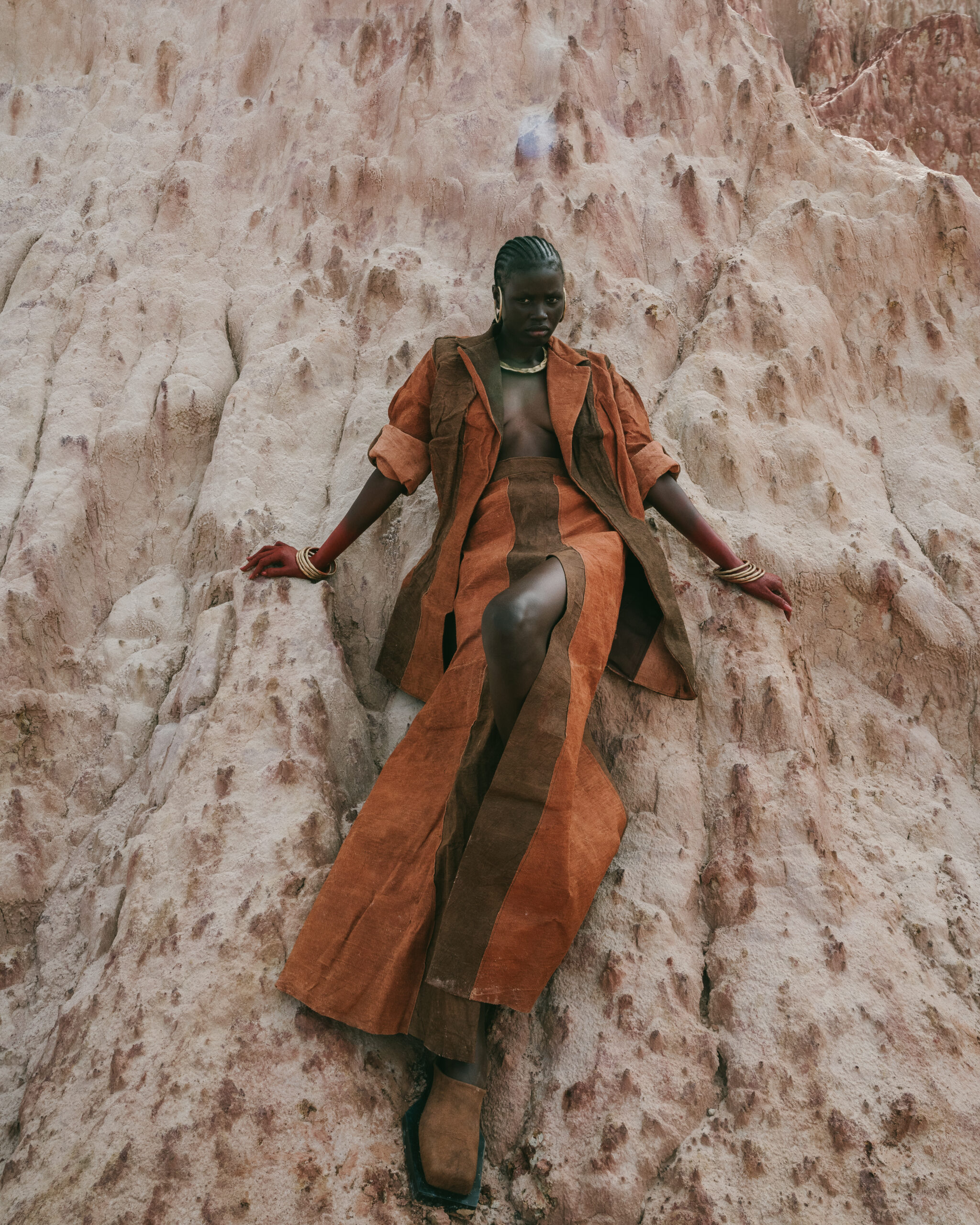
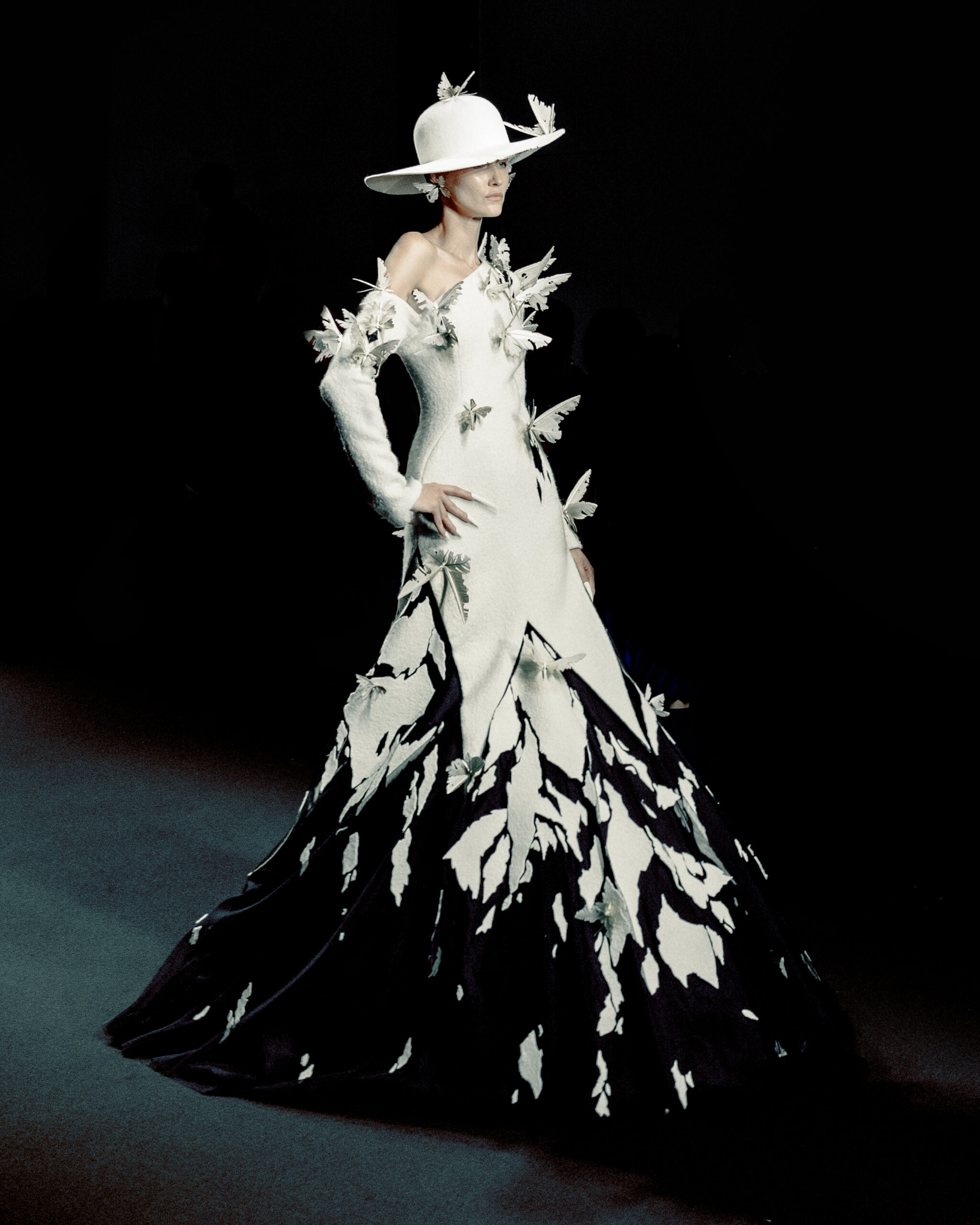
Nostalgia of Mud
The term “Nostalgia of Mud,” which describes a longing for the mud, runs as a leitmotif through the exhibition. Coined by the French playwright Émile Augier in 1855 and popularised by Tom Wolfe’s essay “Radical Chic” (1970), it describes a romantic turn towards the rustic and primitive as a counter to industrialised modernity.
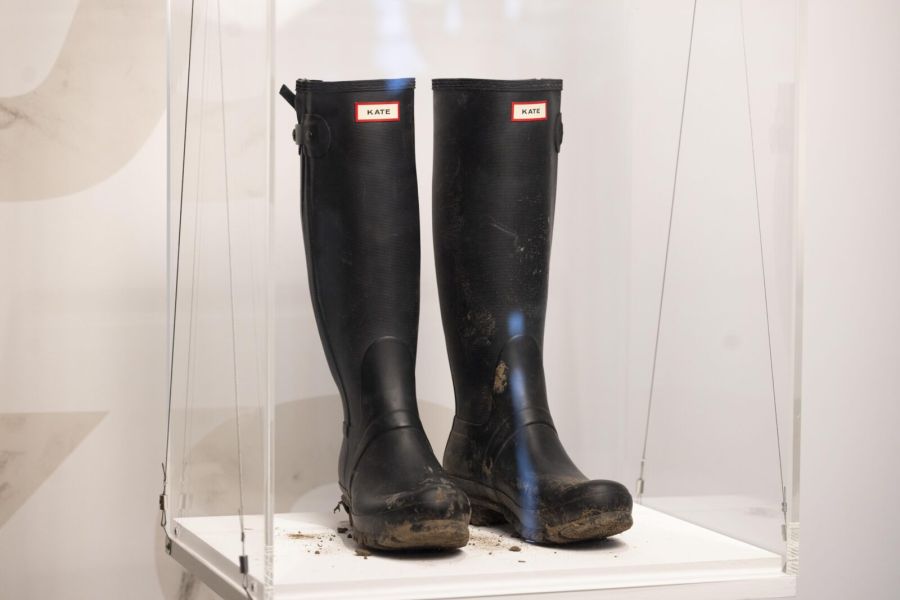
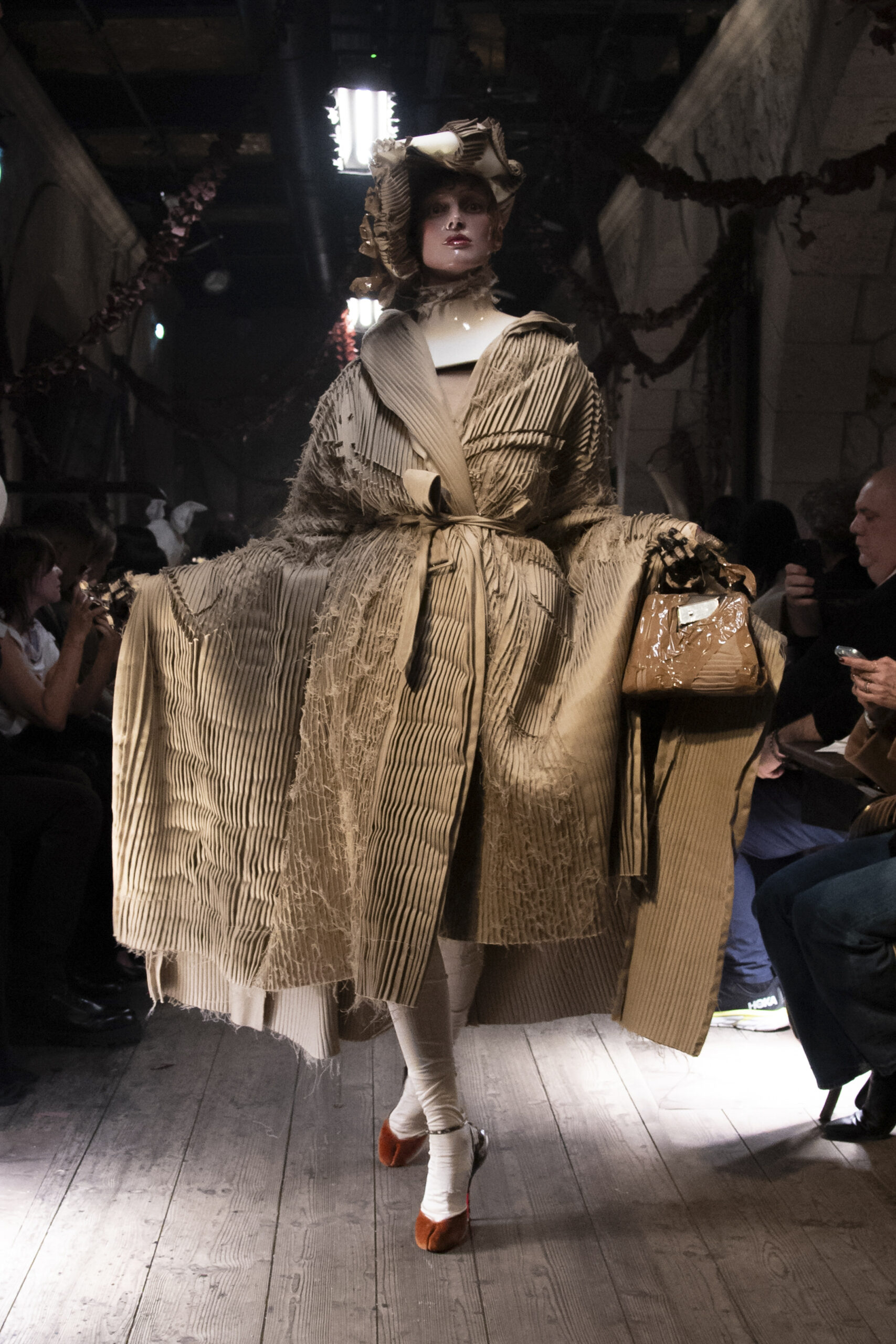
Exemplifying this are the personalised Hunter wellington boots of supermodel Kate Moss (c. 2000), worn on Glastonbury’s muddy fields, and the rubber boots from Queen Elizabeth II’s wardrobe (c. 1960), lent by King Charles III. These objects illustrate the yearning for a bond with nature – whether at festivals or on walks. This stands as a contrast to digital daily life. In fashion, this manifested prominently in 1982 with Malcolm McLaren and Vivienne Westwood’s “Nostalgia of Mud” collection. Drawing on references from ancient togas to sheepskins and forms of indigenous Latin American dress, they aimed to evoke “the roots of our culture in primitive societies”. Today, with greater sensitivity to cultural appropriation, this nostalgia persists in motifs like bogs and folklore, serving as a critique of mass production and digitisation. The exhibition expands on this: Issey Miyake’s Spring/Summer 1983 collection employs mud-dyed textiles in traditional Japanese techniques, drawing on wabi-sabi principles of imperfection. Maison Margiela’s Autumn/Winter 2006 looks simulate ruins, while Alexander McQueen’s “Eshu” (Autumn/Winter 2000) weaves earthy narratives. Miguel Adrover’s “Birds of Freedom” (Autumn/Winter 2001), hand-painted on Egyptian cotton buried by the Nile, addresses beauty and colonialism.
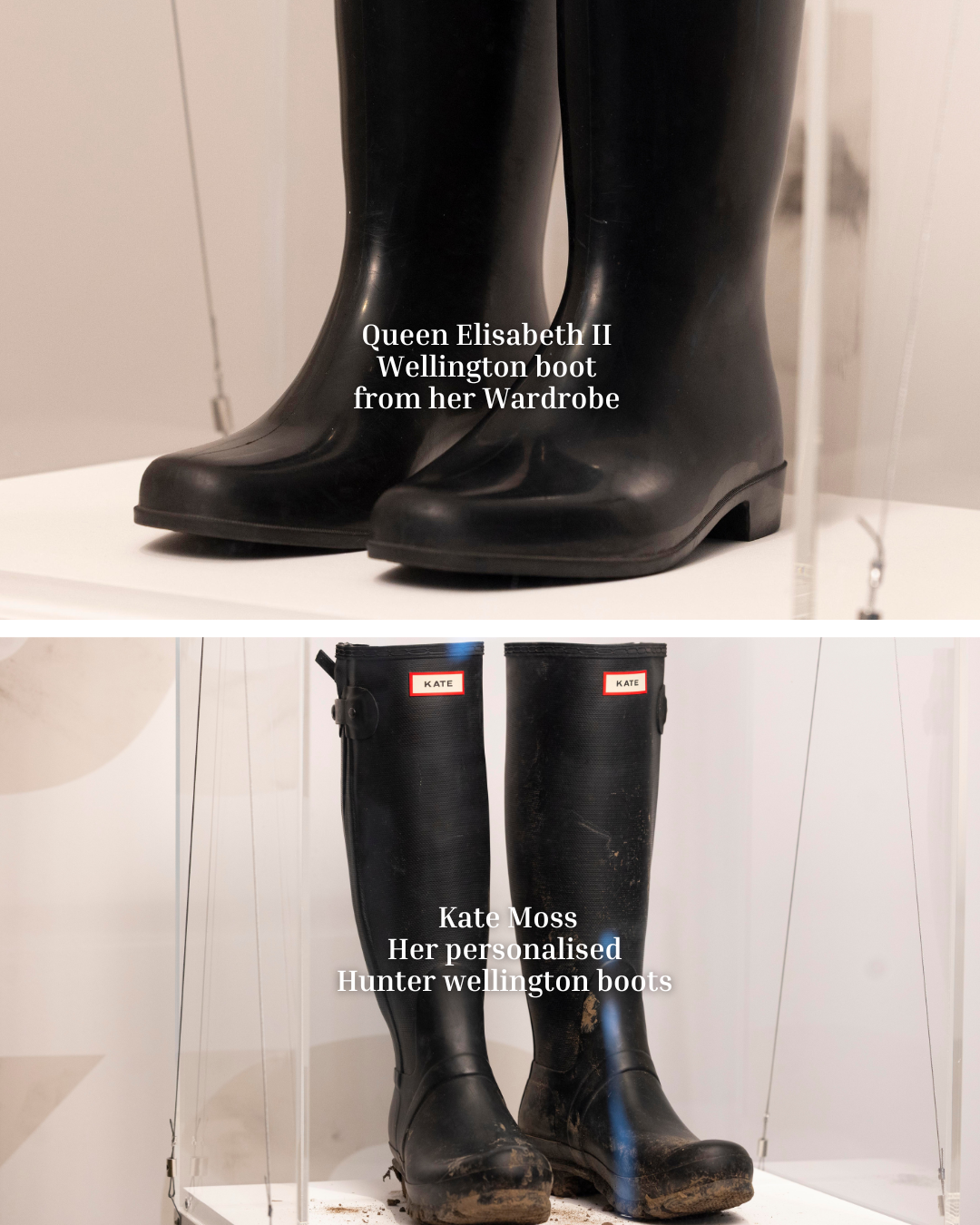
This comparison perfectly captures the exhibition’s essence: the tension between the pristine and the provocative. While one represents the dignity of the untouched, the other celebrates the vibrant energy found in the marks life leaves behind. It shows that true luxury isn’t always silent—sometimes it carries the grit and the stories of the ground we walk on.
The Boot and the Rebel: A Study in British Contrast
At the heart of the “Dirty Looks: Desire and Decay in Fashion” exhibition at the Barbican, a fascinating dialogue unfolds through two pairs of boots. It is a visual manifesto of how we treat time and experience.
-
The Queen’s Wellington: A boot belonging to Queen Elizabeth II stands as a testament to the beauty of preservation. It is clean, cared for, and enduring—a symbol of a life where luxury is found in the quiet continuity of things kept “just so.” It represents a world where the marks of the outside are gently wiped away to maintain a timeless grace.
-
The Kate Moss Glastonbury Legacy: In sharp contrast, we see the mud-splattered Hunter boots that defined an era. When Kate Moss walked through the sludge of Glastonbury, she turned “dirty” into a living aesthetic. These boots aren’t just footwear; they are a pulse of rebellion. The mud is an ornament of experience, a visceral sign of being present in the moment.
Romantic Ruins and Spectral Traces
In the upper galleries, “Romantic Ruins” delves into the fascination with decay: creations such as Alexander McQueen’s tattered garments or Paco Rabanne’s metallic fragments resemble relics. “Spectres of Dirt” examines traces of the impure. This ranges from Jean Paul Gaultier’s stain patterns to Rick Owens’ earth-bound designs. “Stains as Ornament” elevates stains to design elements. Marine Serre’s upcycled materials turn waste into luxury, while Dilara Findikoglu’s works explore bodily impurities. “Leaky Bodies” addresses the “dirtiness” of the body itself. Michaela Stark’s sex-positive designs, in a dedicated installation, celebrate queerness and fluidity. “Glittering Debris” contrasts lustre with remnants. Robert Wun’s burnt silk gowns from “Time” (Autumn/Winter 2023) and “Fear” (Spring/Summer 2023) evoke ephemerality.
Elemental Creation and Renewal
In the lower level, “Elemental Creation” focuses on regenerative approaches. Yuima Nakazato’s “Dust to Dust” transforms waste into cyclical designs. IAMISIGO’s clay-dyed barkcloth (Spring/Summer 2024) reconnects with African traditions. Elena Velez’s “The Longhouse” (Spring/Summer 2024) concludes with a mud-wrestling finale symbolising conflict and renewal. Paolo Carzana’s “Trilogy of Hope” (2024–2025) features hand-dyed organic fabrics. Solitude Studios submerges cloths in Danish bogs, where they are altered by microorganisms. This references ancient rituals. Alice Potts’ biomaterial works and Ma Ke’s “The Earth” (2006–2007), from recycled materials, complement the themes.
A Call to Reflection
“Dirty Looks” extends beyond provocative fashion: it highlights the industry’s status as the world’s third-largest polluter and advocates for alternatives like upcycling and regenerated textiles. Incorporating indigenous and decolonial perspectives, it emphasises a return to authenticity. In a digital age, the exhibition recalls the regenerative potential of fashion. Visitors traversing the Barbican’s spaces encounter not just decay, but possibilities for renewal.
Where to find:
Barbican Art Gallery, Silk Street, London EC2Y 8DS.
Open daily
25th September 2025 – 25th January 2026
Further details: barbican.org.uk
The Breath of the Earth: Navigating Dirty Looks at the Barbican
Walking through the Barbican Art Gallery, the air feels heavy with history and texture. The ‘Dirty Looks’ exhibition doesn’t just show clothes; it shows traces of life. From Hussein Chalayan’s buried silk to the weathered leather of punk pioneers, every piece tells a story of transience. It is a deep, grounding breath in an industry of overproduction. By celebrating what is ‘impure,’ the show reconnects us with a sense of material truth—proving that the most profound objects are those that have truly been lived in.
It explores the shift from subversion to a deeper reconnection with the material world. It highlights how ‘dirt’ is not a flaw but a metaphor for resistance and regeneration. The garments feel born of the earth and shaped by time, reminding us that true sustainability begins with how we perceive objects that age and change alongside us.
It removes the fear of the marks we leave on the world. Instead of chasing a static, sterile image, we are invited to embrace the visceral—the raw touch of materials that have been weathered, burnt, or buried. The exhibition shows that our clothes are a mirror to our own existence: fragile and changing. It is a tactile experience that honors the pulse of life over the coldness of perfection.
The exhibition places the pristine Wellington boot of Queen Elizabeth II alongside the mud-splattered Hunter boots of Kate Moss. It is a study in British contrast: one represents the dignity of careful preservation, while the other celebrates the living energy of experience. It proves that the grit of a moment can be just as powerful as the grace of a polished surface.
Similar Articles
Authenticity Is the New Luxury: Proof, Belonging and Provenance Now Outrank Prestige
The Future of Luxury: Made for the Next Generations
The Cultural Intelligence Dossier: How Africa Sets the Measure of Luxury Value